Every damaged shipment tells the same story: a box that looked fine on paper failed in the real world. Whether you’re shipping cast-iron cookware, glass-top furniture, or a pallet of lab equipment, picking the wrong corrugated box isn’t just a packaging mistake — it’s a line item on your damage-claims spreadsheet.
This guide goes beyond the basic “measure your product and pick a box” advice you’ll find elsewhere. We’ll break down the engineering behind box strength, show you how environmental stress silently weakens even a well-rated box, and walk through the exact matrix you need for products that are both heavy and fragile — a category most guides skip entirely.
Why Corrugated Box Strength Isn’t One Number
Most buyers assume a box’s strength is a single spec they can read off a label. In reality, it’s a combination of three separate measurements, each protecting against a different type of damage.
ECT (Edge Crush Test) — Stacking Strength
ECT measures how much force a box can withstand when compressed from the top down, edge to edge. This is the number that matters most in warehouses and shipping containers, where boxes are stacked five, ten, or twenty high.
- 32 ECT is the industry standard for general e-commerce shipping.
- 44 ECT and above is recommended for heavy or long-transit shipments.
- Higher ECT means better resistance to crushing, warping, and collapse under sustained weight.
Mullen Test (Burst Test) — Puncture Resistance
The Mullen test measures how much pressure it takes to rupture the box wall — critical when you’re shipping items with sharp edges, corners, or protruding hardware that could push through the cardboard from the inside.
- Mullen ratings are expressed in pounds per square inch (psi).
- A box can have excellent ECT and still fail a Mullen test if it’s punctured by an internal edge.
- This is why heavy, angular products (like machine parts or furniture frames) need Mullen-rated protection, not just stacking strength.
GSM (Grams per Square Meter) — Paper Weight
GSM tells you how dense the paper itself is, which affects both rigidity and cost. A higher GSM doesn’t automatically mean a stronger box — it depends on how that paper is combined with flute structure. Think of GSM as one ingredient in the recipe, not the whole dish.
The takeaway: ECT tells you if your box will survive the stack. Mullen tells you if it’ll survive the puncture. GSM tells you what the paper itself is made of. You need all three working together, not just the highest number you can find.
Board Wall Construction: Single, Double, and Triple Wall
Corrugated board comes in three basic constructions, and the difference between them is the number of flute layers sandwiched between liner sheets.
- Single-wall board: One fluted layer between two liners. Ideal for light-to-medium products, retail packaging, and standard e-commerce items.
- Double-wall board (e.g., BC flute): Two fluted layers, giving significantly more crush resistance and puncture protection. This is the workhorse construction for heavier or higher-value shipments.
- Triple-wall board (e.g., BAC or EBC flute): Three fluted layers, built for industrial-grade shipping — think machinery, bulk exports, and palletized freight.
If you’re still deciding between the first two tiers, our breakdown of single-wall vs. double-wall corrugated boxes walks through exactly when the upgrade pays off.
Flute Profiles: The Hidden Variable
Flute type — the wave pattern inside the board — determines both cushioning and stacking strength, independent of wall count.
| Flute | Thickness | Best For |
| A Flute | ~4.7mm | Maximum cushioning, fragile items |
| B Flute | ~2.5mm | Puncture resistance, die-cut boxes |
| C Flute | ~3.6mm | General-purpose shipping, balance of strength and cushioning |
| E Flute | ~1.5mm | Retail packaging, printed boxes |
| F Flute | ~0.8mm | Small, lightweight, high-detail printed items |
A flutes give the best shock absorption but take up more space. E and F flutes are thinner and better suited to branded retail boxes where print quality matters as much as protection — something we cover in detail in our guide to custom printed corrugated boxes.
For heavy-fragile hybrids, C and B flute combinations (used in double-wall board) usually strike the right balance.
Structural Box Styles: RSC, FOL, and Telescopic
Beyond wall count and flute type, the shape of the box construction affects how weight is distributed.
- RSC (Regular Slotted Container): The standard box style, with flaps meeting at the center on both top and bottom. Cost-effective and suitable for most general shipping.
- FOL (Full Overlap Box): The top and bottom flaps fully overlap, doubling the compression strength at the most vulnerable point — the corners. This is the go-to style for heavy items where top-down crushing is the main risk.
- Telescopic boxes: A separate lid slides over the base like a shoebox, allowing the box to accommodate irregular heights and adding an extra layer of protection at the seams. Common in industrial and oversized shipping.
If your product is heavy but doesn’t need custom cushioning, switching from RSC to FOL construction alone can meaningfully reduce compression damage — often without increasing your ECT rating at all.
The Heavy + Fragile Challenge
Here’s where most packaging guides fall short. They treat “heavy” and “fragile” as separate problems with separate solutions. But what happens when your product is both?
Think glass-top tables, enameled cast-iron cookware, ceramic sinks, or precision lab instruments. These items need:
- High compression resistance (because they’re heavy and will be stacked or handled roughly), and
- Shock absorption and puncture resistance (because impact or internal movement can shatter or chip them).
The Solution: Layered Protection Strategy
- Outer layer: Double-wall BC flute board for puncture resistance and stacking strength against external forces.
- Inner layer: A/C flute inserts or foam-lined partitions for shock absorption during handling and transit vibration.
- Corner and edge guards: Custom-density foam or corrugated corner protectors placed at load-bearing points, since corners take the brunt of drops and compression stress.
- Internal bracing: Dividers or partitions that prevent the product from shifting inside the box — movement is often the real cause of fragile-item breakage, not the drop itself.
For heavy industrial products specifically, it’s worth reviewing options from an industrial packaging company in the UAE that can custom-engineer this kind of layered box rather than relying on off-the-shelf sizing.
Environmental Stress: The Factor Everyone Forgets
A box tested at 32 ECT in a lab doesn’t stay at 32 ECT once it enters the real world. Three environmental factors quietly erode strength during transit and storage.
Humidity Degradation
Corrugated cardboard is hygroscopic — it absorbs moisture from the air. In high-humidity environments or during long sea freight journeys, cardboard can lose a significant portion of its rated compression strength. A box that tested fine in a dry warehouse may fail after weeks in a humid shipping container.
Vibration Fatigue
Long-haul transport — especially multi-leg journeys involving trucks, ships, and warehouses — subjects boxes to continuous low-level vibration. This doesn’t cause immediate failure, but it loosens joints, weakens tape adhesion, and gradually fatigues the flute structure.
Multi-Hub Transfer Stress
Every time a box changes hands — from warehouse to truck to sorting hub to delivery van — it experiences a fresh round of compression, impact, and handling stress. A box rated for a single point-to-point journey may not hold up across five or six touchpoints.
Environmental Exposure Table
| Stress Factor | Effect on Nominal ECT | Mitigation |
| High humidity (70%+ RH) | Can reduce effective strength by up to 30–50% | Use moisture-resistant coatings or higher base ECT |
| Extended vibration (7+ days transit) | Weakens flute bonds and tape seals | Reinforced taping, tighter void-fill |
| Multi-hub handling (4+ transfers) | Cumulative compression fatigue | Upgrade to double-wall or FOL construction |
If you’re shipping internationally or through multiple distribution points, don’t design for the lab number — design for the degraded number.
The Cost Trade-Off: When Over-Specifying Actually Saves Money
Most guides warn against over-packaging without showing the math. Here’s a simple way to think about it.
Damage Cost Formula:
Total Cost = (Box Unit Cost × Volume) + (Damage Rate % × Product Replacement Cost × Volume)
Say you’re shipping 10,000 units of a heavy ceramic item:
- 32 ECT box: Costs less per unit, but if damage rate sits at 4% due to insufficient crush resistance, that’s 400 damaged products plus return/replacement logistics.
- 44 ECT box: Costs slightly more per unit, but drops damage rate to 1% — 100 damaged products.
Even with a higher per-box cost, the reduction in damaged goods, returns processing, and customer complaints often makes the stronger box the cheaper option overall. The break-even point depends on your product’s replacement value — the more expensive or fragile the item, the faster the stronger box pays for itself.
This is also where reducing packaging costs intelligently — rather than simply buying cheaper boxes — makes the biggest long-term difference to your margins.
Practical Sizing & Sealing Checklist
Even the right box fails if it’s sized or sealed incorrectly. Use this checklist before you finalize your packaging setup.
Sizing:
- Measure product dimensions and add 2–3 inches per side for cushioning material.
- Confirm cushioning-to-product ratio — heavier items need denser, not just thicker, cushioning.
- Check internal dimensional tolerance so the product can’t shift more than 1 inch in any direction.
- Reference standard corrugated box sizes to avoid custom-order delays where a standard size will do.
Sealing:
- Use H-taping (tape along all seams in an H pattern) for heavy or high-value shipments — standard center-seam taping alone isn’t enough for loads over roughly 15 kg.
- Switch to reinforced water-activated tape (WAT) for heavy boxes — it bonds to the cardboard fibers themselves, unlike pressure-sensitive tape which can peel under stress.
- Reserve pressure-sensitive tape for lighter, standard-weight shipments where speed of packing matters more than maximum bond strength.
- Reinforce bottom seams first — this is where compression failure typically begins.
- Allow void-fill materials (paper, foam, air pillows) to settle before final sealing; account for settling by slightly overfilling.
Getting the tape choice right matters more than most shippers realize — our guide on how to choose the right adhesive packaging tape covers this in more depth if you’re unsure which type fits your load weight.
Quick Decision Framework
Use this as a fast reference when selecting your box:
- Light, standard e-commerce items → Single-wall, 32 ECT, RSC style.
- Heavy, non-fragile items (books, dense hardware) → Double-wall, 44 ECT, FOL style.
- Fragile, lightweight items (glassware, ceramics) → Single or double-wall with A-flute cushioning inserts.
- Heavy AND fragile items (glass tables, enameled cookware, lab equipment) → Double-wall BC flute, FOL construction, custom corner guards, internal bracing, H-taping with WAT.
- Long-transit or humid-climate shipments → Upgrade one ECT tier above your baseline to offset environmental degradation.
Final Thought
Corrugated box strength isn’t about chasing the highest number on a spec sheet — it’s about matching construction, flute type, and sealing method to the actual stresses your product will face, from the warehouse floor to the customer’s doorstep. Get the ECT, Mullen rating, and flute profile aligned with your product’s real-world journey, and you’ll spend less on damage claims than you will on the box itself.
If you’re weighing the bigger picture of why corrugated remains the smartest packaging investment across industries, our overview on why corrugated packaging is best for businesses in the UAE is a solid next read — and if you need boxes engineered specifically for your product mix, our guide to custom corrugated boxes in the UAE walks through the ordering process end to end.

Industrial Packaging Solutions UAE: The Complete.
Packaging Is More Than Just Protection Industrial packaging has evolved far beyond simply placing products in.
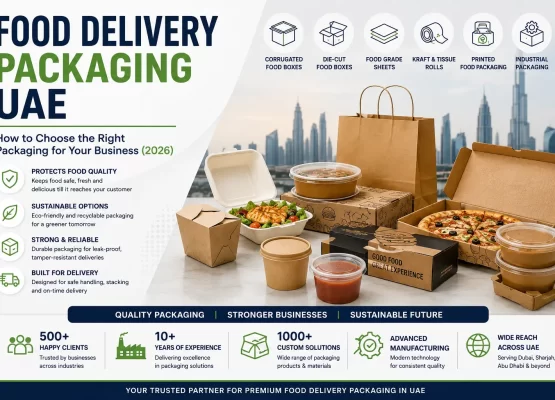
Food Delivery Packaging UAE: How to.
Food delivery has changed the way restaurants, cafés, cloud kitchens and catering businesses think about packaging..