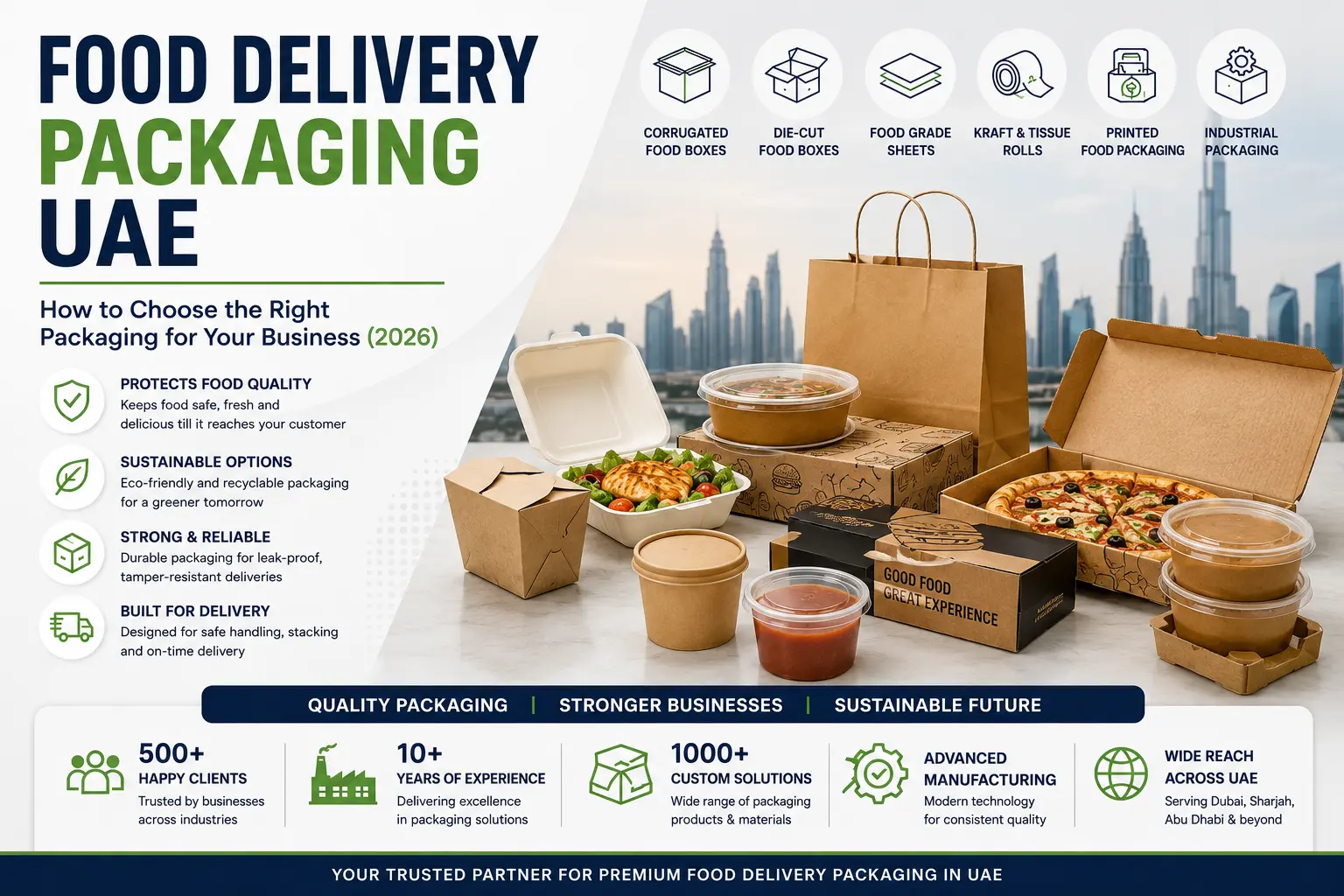
Food delivery has changed the way restaurants, cafés, cloud kitchens and catering businesses think about packaging.
The package is no longer simply something that carries food from the kitchen to the customer. It needs to protect the food, maintain its presentation, withstand handling and delivery, and fit the way the business operates.
For businesses looking for food delivery packaging in the UAE, the right choice therefore depends on much more than price.
A packaging format that works well for a pizza may not be suitable for soup. A container that works for a short takeaway trip may not perform equally well during a longer delivery journey.
There is also an important regulatory consideration. Dubai Municipality maintains requirements and guidance covering food establishments, food transportation and delivery, and food-contact materials.
This guide explains how UAE food businesses can evaluate delivery packaging based on food type, heat retention, leakage, ventilation, durability, presentation, sustainability and operational requirements.
What Is Food Delivery Packaging UAE?
Food delivery packaging refers to containers, boxes, wraps, bags and other packaging formats used to protect prepared food between the restaurant or food business and the customer.
Depending on the menu, this may include:
- Corrugated food boxes
- Paper food containers
- Takeaway boxes
- Burger boxes
- Pizza boxes
- Meal boxes
- Paper bags
- Food trays
- Soup and sauce containers
- Bakery boxes
- Custom printed food packaging
The important point is that there is no universal food delivery package.
The packaging needs to match the food.
Why Choosing the Right Food Delivery Packaging Matters
A customer doesn’t experience the restaurant only through the food itself.
They experience:
Packaging → opening experience → food presentation → smell → texture → meal
If packaging fails at any stage, the customer’s perception of the business can suffer.
For example:
Poor ventilation
Steam can accumulate inside a package and affect the texture of fried or crispy foods.
Weak construction
A box can deform during handling or stacking.
Poor closure
Sauces or liquids can leak during transportation.
Incorrect sizing
Excess empty space can allow food to move around during delivery.
Poor presentation
Even well-prepared food can appear less appealing if the package arrives crushed, stained or poorly sealed.
Packaging is therefore part of the delivery experience, not merely an operational expense.
What Should Food Delivery Packaging Do?
Before choosing a packaging supplier, define the job your packaging needs to perform.
A suitable food delivery package should ideally provide:
1. Food Protection
It should help protect food from contamination and physical damage during handling.
2. Structural Strength
The package should remain stable during packing, stacking and transportation.
3. Appropriate Ventilation
Some foods need ventilation to manage steam and condensation.
4. Leak Resistance
Liquid-heavy foods require packaging designed to minimise leakage.
5. Temperature Management
The packaging should be suitable for the temperature and holding conditions associated with the food.
6. Easy Handling
Kitchen staff should be able to pack orders quickly and consistently.
7. Suitable Presentation
The package should support the way the business wants its food to reach the customer.
8. Food-Contact Suitability
Materials intended to come into contact with food need to meet applicable safety requirements. Dubai Municipality specifically recognises food-contact materials as a regulated category and provides guidance and testing-related services for them.
How to Choose Food Delivery Packaging for Different Foods
One of the biggest mistakes businesses make is choosing packaging based only on appearance or unit price.
Instead, start with the food.
Burgers and Sandwiches
Burger and sandwich packaging needs to provide enough structure to protect the food without unnecessarily trapping moisture.
Look for:
- Appropriate box dimensions
- Secure closure
- Adequate ventilation
- Strong construction
- Easy opening
- Suitable food-contact material
The objective is simple:
Protect the shape while managing moisture.
Pizza Packaging
Pizza boxes need to address several practical requirements:
- Box rigidity
- Correct diameter and height
- Stackability
- Ventilation
- Grease management
- Easy opening
- Resistance to handling
A pizza box that is too small can damage the product.
A box that is too large can allow excessive movement during transportation.
The right size should therefore closely match the pizza dimensions and style.
Dubai Municipality has specifically addressed pizza containers within its food-contact-material safety communications, reinforcing that packaging used for food needs to be considered from a food-safety perspective as well as a functional one.
Fried and Crispy Foods
Fried foods present a particular packaging challenge.
When hot food releases steam, that moisture can condense inside a closed package.
If the package doesn’t manage ventilation appropriately, foods such as:
- French fries
- Fried chicken
- Nuggets
- Spring rolls
- Fried snacks
can lose their desired texture.
For these products, businesses should evaluate:
Ventilation + moisture management + structural strength.
Simply choosing a completely sealed container isn’t always the best solution.
Curries, Sauces and Liquid Foods
Liquid foods require a different packaging approach.
Examples include:
- Curries
- Soups
- Gravies
- Sauces
- Stews
- Rice dishes with liquid accompaniments
Here, the priorities shift toward:
Leak resistance + secure closure + container rigidity + appropriate capacity + separation of sauces where necessary.
The package should also be tested under realistic delivery conditions rather than only being checked while sitting on a kitchen counter.
Bakery and Dessert Packaging
Cakes, pastries and desserts often require packaging that prioritises presentation.
Important considerations include:
- Product visibility
- Internal space
- Structural protection
- Moisture control
- Easy opening
- Stackability
For delicate products, the packaging should prevent unnecessary movement during transport.
A beautiful dessert that arrives damaged has effectively lost part of its value.
How to Choose the Correct Packaging Size
Size is one of the most overlooked aspects of food delivery packaging.
A package should not simply be “large enough.”
It should be appropriately sized.
Too Small — Food can be compressed or damaged.
Too Large — Food may move excessively during delivery.
Correct Size — The package provides sufficient space while limiting unnecessary movement.
For businesses with multiple portion sizes, consider creating a standard packaging matrix:
| Food/Product | Small | Medium | Large |
|---|---|---|---|
| Burgers | ✓ | ✓ | — |
| Meals | ✓ | ✓ | ✓ |
| Pizza | — | ✓ | ✓ |
| Desserts | ✓ | ✓ | — |
| Bakery items | ✓ | ✓ | ✓ |
The exact sizes should be determined through actual product measurements and delivery testing.
How to Test Food Delivery Packaging Before Ordering in Bulk
Don’t approve packaging based only on a sample sitting on a desk.
Run a real-world packaging test.
Step 1: Pack the actual food
Use the same portion size and preparation process used during normal operations.
Step 2: Close the package
Check whether the closure is secure and practical for kitchen staff.
Step 3: Simulate transportation
Move the packed order as it would normally be handled during delivery.
Step 4: Check the package
Look for:
- Leaks
- Deformation
- Grease penetration
- Condensation
- Broken closures
- Food movement
Step 5: Check the food
Evaluate:
- Temperature
- Texture
- Appearance
- Portion presentation
Step 6: Ask staff for feedback
Packaging that looks good but takes twice as long to assemble may create operational problems.
This testing approach is much more useful than choosing packaging solely from a catalogue.
Food Delivery Packaging and Food Safety in the UAE
Food businesses should treat packaging as part of their broader food-safety process.
Dubai Municipality provides dedicated resources for food establishments, including guidance related to food transportation and delivery vehicles.
It also has a dedicated framework for food-contact materials, and its technical guidance includes requirements relating to food-contact-material safety.
Dubai Municipality also provides testing services for food-contact materials, including tests for migration from food packaging into food simulants.
This matters because packaging isn’t isolated from the food.
The material can come into direct or indirect contact with the food, so businesses should consider whether the packaging is appropriate for its intended application and conditions of use.
Sustainable Food Delivery Packaging in the UAE
Sustainability is becoming increasingly important in packaging decisions.
However, businesses shouldn’t simply choose a package because it is marketed as “eco-friendly.”
Instead, evaluate:
- Material composition
- Intended use
- Food-contact suitability
- Disposal requirements
- Recyclability where relevant
- Available alternatives
- Packaging weight
- Overall operational practicality
Dubai’s regulatory landscape is also changing. The final phase of Dubai’s single-use plastic restrictions came into effect on 1 January 2026, covering a range of single-use plastic products including plastic plates, cutlery, beverage cups and lids, while earlier phases had already addressed products such as polystyrene food containers.
Therefore, UAE businesses should review the current applicable requirements before selecting packaging materials rather than relying on older packaging practices. For a broader look at material choices, see our guide to sustainable packaging in the UAE.
Sustainable Does Not Automatically Mean Better
A useful packaging decision needs to consider the entire application.
For example, replacing a package with a different material may not solve the underlying problem if:
- It doesn’t protect the food.
- It leaks.
- It fails during delivery.
- It creates excessive food waste.
- It doesn’t meet applicable food-contact requirements.
The goal should be to select fit-for-purpose packaging with appropriate environmental characteristics, rather than choosing a material solely because it has a sustainability label.
Custom Food Packaging vs Standard Packaging
Businesses usually have two broad options.
Standard Packaging
Standard packaging is useful when:
- Orders are relatively straightforward
- Budget is a major consideration
- Speed of procurement matters
- Branding requirements are limited
Custom Packaging
Custom packaging can be useful when:
- Brand visibility is important
- The business has specific product dimensions
- Different product ranges require different formats
- The business wants a distinctive unboxing experience
- Printed branding is part of the marketing strategy
Custom packaging doesn’t necessarily mean every package needs an elaborate design.
Even simple branding elements can make packaging more recognisable. Explore our guide on Custom Printed Corrugated Boxes to see how branding and structural protection can work together.
How Packaging Can Support Restaurant Branding
Food delivery packaging can act as a physical brand touchpoint.
A customer may interact with the packaging before they taste the food.
Branding opportunities can include:
- Logo
- Brand colours
- Tagline
- Website
- Social media handle
- QR code
- Reordering information
- Product information
However, branding should not compromise usability.
A package still needs to:
Protect → contain → transport → present.
Branding comes after those fundamental functions.
Packaging Cost: Don’t Compare Only the Unit Price
Suppose Package A costs less per unit than Package B.
That doesn’t automatically make A cheaper.
Consider the total packaging cost.
It can include:
Purchase cost + wastage + packing time + leakage + damaged food + storage + returns/customer complaints
For example, if cheaper packaging causes more leakage or damaged products, the apparent saving can disappear quickly.
A better metric is:
Cost per successful delivered order
This provides a more realistic comparison.
How to Choose a Food Packaging Supplier in the UAE
Before committing to a supplier, ask:
Product Questions
- What materials are available?
- What sizes are available?
- Are samples available?
- Can the packaging be customised?
- What food types are the products designed for?
Food-Safety Questions
- Is the product intended for food contact?
- What documentation is available?
- Are relevant test reports or conformity documents available?
- What are the recommended conditions of use?
Operational Questions
- What is the minimum order quantity?
- What is the lead time?
- Can the supplier maintain consistent quality?
- What are the storage requirements?
- Can repeat orders be supplied consistently?
Customisation Questions
- What printing options are available?
- What artwork specifications are required?
- What are the setup costs?
- What is the expected production timeline?
These questions help businesses compare suppliers on quality and reliability, rather than price alone.
Food Delivery Packaging Checklist
Before selecting a package, use this checklist:
Food Compatibility
- ☐ Suitable for the food type
- ☐ Appropriate size
- ☐ Suitable for the expected temperature
- ☐ Appropriate moisture/ventilation characteristics
Safety
- ☐ Intended for food contact
- ☐ Appropriate documentation available
- ☐ Suitable for intended conditions of use
Delivery Performance
- ☐ Strong enough for transportation
- ☐ Secure closure
- ☐ Leak-resistant where required
- ☐ Stackable where required
- ☐ Protects food presentation
Operations
- ☐ Easy for staff to pack
- ☐ Easy for customers to open
- ☐ Available in required quantities
- ☐ Practical storage requirements
Branding
- ☐ Suitable surface for printing
- ☐ Brand visibility
- ☐ Appropriate design
- ☐ Space for QR code/contact information where needed
Sustainability
- ☐ Material choice reviewed
- ☐ Applicable UAE requirements checked
- ☐ Disposal/recycling considerations understood
- ☐ Avoids unnecessary packaging
10 Questions to Ask Before Buying Food Delivery Packaging
- Is this packaging suitable for my specific food?
- Will it handle the expected delivery conditions?
- Does it provide adequate ventilation?
- Is it sufficiently resistant to leakage?
- Is the size appropriate for my portions?
- Is the material suitable for food contact?
- Can my kitchen staff pack it efficiently?
- Can the supplier maintain consistent quality?
- Does the packaging align with current UAE requirements?
- Can the packaging support my branding and sustainability objectives?
Common Food Packaging Mistakes Businesses Make
Choosing the Cheapest Package
Low purchase price doesn’t necessarily mean low total cost.
Using One Package for Everything
Different foods have different packaging requirements.
Ignoring Ventilation
This can negatively affect the texture of certain foods.
Ordering Large Quantities Before Testing
A packaging problem becomes expensive when thousands of units have already been purchased.
Focusing Only on Appearance
A beautiful package that fails during delivery isn’t effective packaging.
Ignoring Food-Contact Requirements
Packaging should be assessed for its intended food-contact application and relevant requirements.
Overlooking Storage
Large packaging orders require suitable warehouse or storage space.
A Simple Food Delivery Packaging Decision Framework
When evaluating any packaging option, score it across six areas:
| Factor | Weight |
|---|---|
| Food compatibility | 25% |
| Delivery performance | 20% |
| Food-contact suitability | 20% |
| Operational efficiency | 15% |
| Cost | 10% |
| Branding & sustainability | 10% |
| Total | 100% |
This isn’t an official industry standard. It is a practical comparison framework businesses can use when evaluating packaging options.
The weighting can also be changed depending on the business.
A cloud kitchen handling liquid meals, for example, may place greater importance on leakage performance.
A premium dessert brand may place more emphasis on presentation.
Final Thoughts
Choosing food delivery packaging in the UAE shouldn’t begin with:
“What is the cheapest container?”
It should begin with:
“What does my food need during the journey from kitchen to customer?”
From there, evaluate the packaging’s material, size, structure, ventilation, leak resistance, food-contact suitability, delivery performance, operational efficiency, branding potential and sustainability considerations.
UAE food businesses should also keep up with applicable local requirements. Dubai Municipality provides specific resources covering food establishments, delivery, food-contact materials and related safety considerations, while Dubai’s single-use plastic regulations have also moved into their final phase from January 2026.
The right packaging is therefore not necessarily the most expensive, the most attractive or the most sustainable-looking option.
It is the package that performs reliably for the food, the operation and the customer.
Why Choose Al Mufeed Packaging?
Al Mufeed Packaging manufactures corrugated packaging solutions for food, retail, e-commerce, and industrial businesses across the UAE.
For food and delivery-focused businesses, our range includes:
- Custom Food Boxes
- Custom Printed Corrugated Boxes
- Corrugated Carton Boxes
- Die-Cut Boxes for product-specific shapes
Our team can help restaurants, cloud kitchens, and catering businesses select appropriately sized and structured corrugated packaging based on the food type, delivery conditions, and branding requirements discussed in this guide.
FAQs
What is the best packaging for food delivery in the UAE?
There is no single best option. The right packaging depends on the food type, portion size, temperature, moisture, delivery distance, handling requirements and applicable food-contact requirements.
What packaging is suitable for hot food delivery?
Hot food requires packaging that is appropriate for the food and expected temperature conditions. Ventilation can also be important for foods where steam and condensation could affect texture.
Is sustainable food packaging available in the UAE?
Yes, businesses can evaluate various alternative materials and formats. However, sustainability claims should be considered alongside food-contact suitability, performance, applicable UAE requirements and end-of-life considerations.
How can restaurants reduce food packaging costs?
Restaurants can reduce total packaging costs by standardising suitable sizes, reducing unnecessary packaging, testing products before bulk purchasing and comparing the total cost per successful delivered order rather than unit price alone.
How important is custom food packaging?
Custom packaging can strengthen brand recognition and create a consistent customer experience, but functional performance should come first.
What should I check when buying food packaging in the UAE?
Check food compatibility, size, structural strength, leakage resistance, ventilation, food-contact suitability, supplier reliability, minimum order quantities, customisation options and current applicable UAE requirements.

Food Packaging Boxes UAE: How to.
Walk into any cloud kitchen in Dubai on a Friday night and you'll see the real.
Corrugated Sheets UAE: Types, Uses &.
The UAE is hard on building materials. Summer heat passes 45°C. UV is relentless. Coastal air.