Introduction
Packaging plays an important role in protecting products during storage, handling, transportation, and delivery. For businesses operating in the UAE, selecting the right packaging material can influence product safety, logistics efficiency, storage requirements, branding, and overall packaging costs.
The UAE has a diverse business environment covering e-commerce, retail, manufacturing, logistics, food and beverage, electronics, furniture, textiles, and other industries. Each sector has different packaging requirements.
Understanding the available packaging materials in the UAE businesses can use makes it easier to select solutions based on product type, weight, transportation conditions, storage requirements, and budget.
From corrugated boxes and cardboard sheets to corrugated rolls and custom packaging, businesses can choose from different materials and formats depending on their application.
This guide explains the major types of packaging materials used by businesses in the UAE, their applications, advantages, and the factors to consider before choosing a packaging solution.
What Are Packaging Materials?
Packaging materials are materials used to contain, protect, transport, store, and present products.
They can be used at different stages of the supply chain, including:
- Product packaging
- Secondary packaging
- Transportation packaging
- Protective packaging
- Retail packaging
- Industrial packaging
- E-commerce packaging
The right packaging material depends on the product and the conditions it will experience throughout its journey.
For example, a lightweight retail product may require a simple corrugated carton, while heavy industrial components may require stronger board construction and additional protective materials.
Why Packaging Materials Matter for UAE Businesses
Businesses need packaging that can withstand handling, transportation, warehouse storage, and delivery conditions.
The right packaging material can provide several benefits.
Product Protection
Packaging helps protect products from impacts, compression, scratches, dust, and other forms of damage during transportation and storage.
Efficient Transportation
Well-designed packaging can help businesses use warehouse and transportation space more efficiently.
Storage Optimization
Correctly sized packaging can make stacking and storage easier, particularly for businesses handling large quantities of products.
Brand Presentation
Custom packaging can help businesses create a consistent visual identity through logos, colours, graphics, and product information.
Cost Management
Selecting the right material and box construction can help businesses avoid unnecessary packaging material and transportation costs.
Customer Experience
Packaging is often the first physical interaction a customer has with an e-commerce or retail brand. Well-designed packaging can create a more professional experience.
Packaging Materials Used in the UAE
Businesses use different packaging materials depending on the product and application.
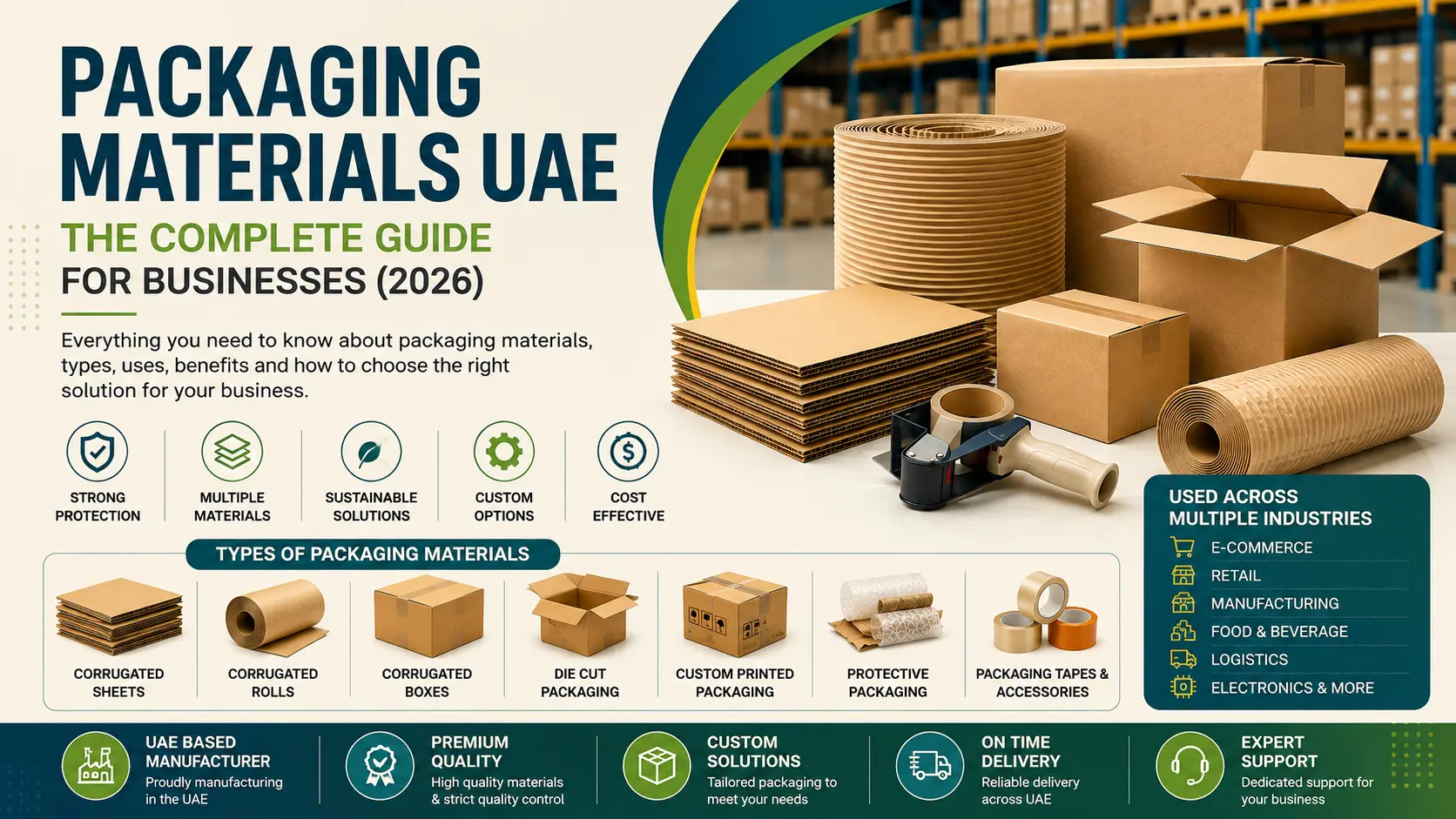
Common categories include:
- Corrugated cardboard
- Corrugated boxes
- Corrugated sheets
- Corrugated rolls
- Die-cut packaging
- Kraft paper
- Protective packaging materials
- Adhesive tapes
- Custom printed packaging
Among these options, corrugated packaging is particularly versatile because it can be manufactured in different sizes, board constructions, flute profiles, and designs.
Corrugated Packaging Materials
Corrugated cardboard is made using layers of paperboard, including fluted paper positioned between liner sheets.
The structure creates a lightweight material with useful strength and cushioning characteristics.
Corrugated packaging can be manufactured in different constructions depending on the application.
Common Applications
- Shipping cartons
- E-commerce packaging
- Retail packaging
- Industrial packaging
- Product storage
- Transportation packaging
- Export packaging
Businesses can select different board constructions based on product weight, stacking requirements, transportation conditions, and required protection.
For a detailed explanation of corrugated packaging, read: Corrugated Packaging Boxes UAE: The Complete Guide for Businesses (2026)
Corrugated Cardboard Sheets
Corrugated cardboard sheets are flat sheets of corrugated material that can be used for protection, separation, cushioning, and layering.
They can be particularly useful for businesses that need additional protection inside packaging or during palletized transportation.
Common Applications
- Layer pads
- Product separation
- Surface protection
- Interleaving
- Industrial cushioning
- Pallet protection
- Furniture protection
Corrugated sheets can also be supplied in standard or custom dimensions according to business requirements.
Corrugated Rolls
Corrugated rolls provide flexible protection for products with different shapes and dimensions.
Unlike pre-formed boxes, rolls can be cut according to the size of the item being protected.
Common Applications
- Furniture protection
- Glass protection
- Electronics
- Metal components
- Fragile products
- Industrial equipment
- Surface protection
Corrugated rolls can help businesses protect irregularly shaped products without requiring a separate box for every application.
Corrugated Boxes
Corrugated boxes are one of the most widely used packaging solutions for businesses.
They can be produced in different sizes, board strengths, flute profiles, and configurations.
Common Types
- Single-wall boxes
- Double-wall boxes
- Triple-wall boxes
- Regular carton boxes
- Die-cut boxes
- Custom printed boxes
- Heavy-duty boxes
The appropriate box construction depends on the weight and fragility of the product, stacking requirements, transportation conditions, and intended use.
For a detailed comparison, read: Single Wall vs Double Wall Corrugated Boxes: Which One Should You Choose? (2026)
Custom Packaging Materials
Standard packaging does not always meet the requirements of every business.
Products can have unique dimensions, shapes, weights, or protection requirements. Custom packaging allows the packaging structure to be designed around the product.
Custom packaging can include:
- Custom dimensions
- Die-cut designs
- Internal partitions
- Custom printing
- Special board construction
- Product-specific inserts
- Branded packaging
Benefits of Custom Packaging
- Better product fit
- Reduced unnecessary empty space
- Improved protection
- Better presentation
- More efficient material usage
- Stronger brand identity
For businesses that need packaging designed around specific products, custom packaging can provide a more efficient solution than relying entirely on standard box sizes.
Packaging Materials for E-commerce Businesses
E-commerce businesses need packaging that can withstand multiple stages of handling.
A typical online order may move through:
Warehouse → Picking → Packing → Courier → Distribution Centre → Delivery → Customer
Packaging must therefore provide adequate protection throughout the process.
Recommended Packaging Considerations
- Correct box dimensions
- Appropriate board strength
- Secure sealing
- Product cushioning
- Easy handling
- Branding requirements
- Shipping efficiency
Right-sized packaging is particularly important for e-commerce because unnecessary box volume can increase material usage and transportation costs. See our guide on choosing the right corrugated box size for more detail.
Packaging Materials for Retail Businesses
Retail packaging needs to balance protection with presentation.
For retail businesses, packaging may need to communicate:
- Brand identity
- Product information
- Handling instructions
- Product specifications
- Barcodes
- Promotional messaging
Custom printed corrugated boxes can combine transportation protection with brand visibility.
For businesses interested in branded packaging, explore: Custom Printed Corrugated Boxes: How Packaging Can Strengthen Your Brand (2026)
Packaging Materials for Manufacturing
Manufacturing businesses often have more demanding packaging requirements.
Products may be:
- Heavy
- Large
- Fragile
- Irregularly shaped
- Sensitive to impact
- Stored for extended periods
Industrial packaging may therefore require stronger corrugated construction, custom dimensions, internal protection, and suitable stacking performance.
Packaging should be designed according to the complete logistics process rather than simply the product’s dimensions.
For more information, read: Industrial Packaging Solutions UAE: The Complete Guide for Businesses (2026)
Packaging Materials for Food & FMCG
Food and FMCG businesses often require packaging that supports efficient handling, transportation, storage, and retail presentation.
Packaging requirements may vary depending on:
- Product weight
- Product dimensions
- Distribution method
- Storage conditions
- Retail requirements
- Branding requirements
Where packaging comes into direct or indirect contact with food products, businesses should confirm that the selected packaging components meet the applicable requirements for the intended application, as regulated by the Ministry of Industry and Advanced Technology (MoIAT), the UAE’s national standards body.
Packaging Materials for Electronics
Electronics can be sensitive to impacts, pressure, scratches, and movement during transportation.
Packaging may therefore require:
- Appropriate corrugated board strength
- Internal cushioning
- Dividers
- Custom inserts
- Correct box dimensions
The packaging should keep the product stable while providing sufficient protection against normal handling conditions.
Packaging Materials for Furniture
Furniture and furniture components often require larger packaging formats and additional surface protection.
Corrugated sheets and rolls can be useful for protecting:
- Table surfaces
- Cabinets
- Furniture panels
- Glass components
- Finished surfaces
Custom corrugated boxes can also be designed for smaller furniture components and accessories.
Sustainable Packaging Materials UAE Businesses Can Consider
Sustainability has become an increasingly important consideration in packaging decisions.
Businesses can evaluate packaging based on:
- Recyclability
- Material efficiency
- Recycled content
- Product-to-packaging ratio
- Reusability
- Transportation efficiency
- End-of-life disposal
Corrugated packaging is widely used because paper-based packaging can be recovered and recycled through established recycling systems, and much of it is sourced from forests certified by the Forest Stewardship Council (FSC).
However, sustainability should be evaluated across the complete packaging lifecycle rather than based only on the material name.
Reducing unnecessary packaging volume, selecting appropriate material quantities, and improving transportation efficiency can also contribute to more efficient packaging practices.
How to Choose the Right Packaging Material
Choosing packaging should begin with the product and its supply chain.
1. Understand the Product
Identify the product’s:
- Dimensions
- Weight
- Shape
- Fragility
- Surface sensitivity
2. Consider Transportation
Determine how the product will be transported.
Consider:
- Local delivery
- Courier delivery
- Pallet transportation
- Long-distance transportation
- Export shipments
3. Determine Required Protection
Assess the potential risks during handling and transportation.
Products requiring greater protection may need stronger board construction or additional internal packaging.
4. Consider Storage
If products will be stored for extended periods, packaging should support the expected stacking and warehouse conditions.
5. Select the Appropriate Box Size
The box should provide enough space for the product and any required protective materials without creating excessive empty space.
6. Consider Branding
Retail and e-commerce businesses may benefit from custom printed packaging that communicates their brand identity.
7. Evaluate Total Cost
Packaging cost is not limited to the price of the box.
Consider:
- Material cost
- Printing
- Storage
- Transportation
- Protective materials
- Product damage
- Packaging labour
A slightly higher-quality packaging solution can sometimes reduce overall costs by improving product protection and logistics efficiency.
Factors That Affect Packaging Material Cost
Packaging prices can vary depending on several factors.
Material
The type and grade of paperboard affect the final cost.
Box Size
Larger boxes generally require more material.
Board Construction
Single-wall, double-wall, and triple-wall structures have different material requirements.
Printing
Custom printing adds production requirements depending on the design and print specifications.
Quantity
Production volume can influence the per-unit cost.
Customization
Special dimensions, die-cut designs, inserts, and structural requirements can affect pricing.
Delivery
The delivery location and order volume can influence logistics costs.
Businesses should compare the total packaging solution rather than focusing only on the initial unit price.
Common Packaging Material Mistakes
Using the Wrong Material
Selecting packaging based only on price can result in inadequate protection.
Choosing Oversized Boxes
Excessive empty space can increase packaging and transportation costs.
Ignoring Product Weight
Box dimensions should be considered together with board strength.
Using the Same Packaging for Every Product
Different products often require different packaging specifications.
Ignoring Branding
For customer-facing products, plain packaging may miss an opportunity to strengthen brand recognition.
Ordering Without Understanding Specifications
Businesses should clearly define dimensions, board construction, printing requirements, quantity, and delivery expectations before placing an order.
Why Work With a Packaging Manufacturer?
Working directly with a packaging manufacturer can provide greater control over the packaging process.
A manufacturer can help businesses with:
- Material selection
- Box dimensions
- Structural design
- Board construction
- Printing
- Production
- Quality control
- Delivery
For businesses with recurring packaging requirements, working directly with a manufacturer can also simplify procurement and improve consistency across orders.
Why Choose Al Mufeed Packaging?
Al Mufeed Packaging is a corrugated packaging manufacturer based in Al Sajaa Industrial Oasis, Sharjah, serving businesses across the UAE.
The company manufactures corrugated carton boxes, die-cut boxes, corrugated cardboard sheets, and corrugated rolls, along with value-added services including box printing, stitching, pasting, and adhesive tape solutions.
Al Mufeed operates its production in-house, allowing the company to maintain control over manufacturing and quality. Its product range supports applications across e-commerce, logistics, manufacturing, retail, electronics, furniture, textiles, food and FMCG, and other industries.
Packaging Products
Packaging Services
Businesses can select packaging based on product dimensions, required protection, board construction, branding, and transportation requirements.
For custom requirements, providing the supplier with accurate product dimensions, expected quantity, application, and delivery location can help create a more suitable packaging specification.
Packaging Materials UAE: A Practical Selection Checklist
Before ordering packaging materials, businesses should evaluate:
- Product dimensions
- Product weight
- Product fragility
- Required protection
- Box dimensions
- Board construction
- Flute profile
- Printing requirements
- Expected order quantity
- Storage conditions
- Transportation method
- Delivery location
- Sustainability requirements
- Total packaging cost
A clear specification can reduce production errors and make it easier for a packaging manufacturer to provide the appropriate solution.
Frequently Asked Questions
What are the most common packaging materials used in the UAE?
Common packaging materials include corrugated cardboard, corrugated boxes, corrugated sheets, corrugated rolls, die-cut packaging, protective materials, kraft paper, and adhesive tapes.
Which packaging material is best for shipping products?
Corrugated packaging is widely used for shipping because it can be produced in different strengths and dimensions and can provide protection during handling and transportation. The appropriate construction depends on the product’s weight, fragility, and transportation requirements.
What is the difference between corrugated sheets and corrugated rolls?
Corrugated sheets are flat pieces of corrugated material, while corrugated rolls are supplied in flexible rolled formats. Sheets are commonly used for layering and separation, while rolls can be wrapped around products for flexible protection.
Can packaging materials be customized?
Yes. Packaging can be customized in terms of dimensions, board construction, printing, die-cut shapes, and other structural requirements.
Are corrugated packaging materials recyclable?
Paper-based corrugated packaging is commonly recyclable, subject to local collection and recycling systems and the condition of the material.
How do I choose the right packaging material?
Start by evaluating the product’s dimensions, weight, fragility, transportation method, storage requirements, and desired presentation. Then select the material and construction that provide the required protection and efficiency.
Can businesses order custom packaging in the UAE?
Yes. UAE packaging manufacturers can produce customized packaging according to product dimensions, quantities, board specifications, printing requirements, and other project requirements.
How can packaging reduce business costs?
Right-sized packaging can reduce unnecessary material usage and transportation volume. Appropriate packaging can also help reduce product damage, storage inefficiencies, and packaging labour.
Conclusion
Choosing the right packaging materials around UAE businesses use is an important part of protecting products, controlling logistics costs, improving storage efficiency, and creating a professional customer experience.
Corrugated boxes, cardboard sheets, corrugated rolls, die-cut packaging, and custom packaging solutions can serve different requirements across e-commerce, retail, manufacturing, logistics, food and FMCG, electronics, furniture, and other industries.
The best packaging solution depends on the product, transportation conditions, storage requirements, protection level, branding needs, order quantity, and overall cost.
Instead of selecting packaging based only on the lowest unit price, businesses should evaluate the complete packaging lifecycle, from manufacturing and storage to transportation and final delivery.
For businesses looking for customized packaging materials in the UAE, Al Mufeed Packaging provides corrugated packaging products and manufacturing services from its Sharjah facility, with solutions designed for different business and industry requirements.
Contact Al Mufeed Packaging to discuss your product dimensions, packaging requirements, and quantities.

Adhesive Tape UAE: Complete Guide to.
Adhesive tape is a small but essential component of modern packaging. From sealing shipping cartons to.
Corrugated Box Strength: How to Choose.
Every damaged shipment tells the same story: a box that looked fine on paper failed in.