What Is Pharmaceutical Packaging, and Why Does It Matter?
Packaging in the pharmaceutical industry has four jobs:
- Protect the product from moisture, oxygen, light, and contamination.
- Preserve stability through the full shelf life.
- Identify the product clearly, so patients and pharmacists never confuse it.
- Prove authenticity, so counterfeits are easy to catch.
Get one of these wrong and the consequences are real. Recalls cost money. Regulatory action costs time. Patient harm costs trust that is hard to rebuild.
Types of Pharmaceutical Packaging
Most guides split types of pharmaceutical packaging into three levels. Knowing which level you are buying for helps you brief suppliers correctly.
Primary Packaging
Primary packaging touches the drug directly. Common formats include:
- Blisters and strip packs
- Glass vials and ampoules
- HDPE and PET bottles
- Sachets and pouches
- Pre-filled syringes and cartridges
This layer needs pharma-grade materials and strict extractables and leachables control.
Secondary Packaging
Secondary packaging holds and presents the primary pack. It carries the information patients read. Examples include:
- Mono cartons
- Leaflet inserts
- Multipack sleeves
- Display and dispensing boxes
Tertiary Packaging
Tertiary packaging moves products through distribution. Think corrugated shipping cartons, pallets, stretch film, and tape. It protects against crushing, vibration, and humidity during storage and transport.
Tertiary packaging is often overlooked, yet it is where many transit losses start. If you are specifying shipper cartons, our guides on corrugated packaging boxes in the UAE and single wall vs double wall corrugated boxes show how board grade affects stack strength.
Drug Packaging Types and Materials: What Works Best
Material choice sets your barrier level, cost, and weight. Here is how the main options compare.
| Material | Strengths | Watch-outs |
| Glass (Type I) | Excellent chemical inertness, full barrier | Heavy, breakable, higher freight cost |
| HDPE | Durable, good moisture barrier, light | Limited oxygen barrier |
| PET | Clear, good oxygen barrier, recyclable | Lower heat tolerance than HDPE |
| Aluminium foil | Near-total barrier to light, moisture, gas | Cost; not transparent |
| Laminate films (PET/Alu/PE) | Flexible, high barrier, lightweight | Hard to recycle |
| Paperboard and corrugated | Printable, protective, recyclable | Needs moisture management in humid climates |
For primary packs, ask your supplier for material certifications such as USP Class VI or equivalent, plus migration test data. For outer packs, ask about board strength, coatings, and humidity performance. Our overview of packaging materials in the UAE explains those options in plain terms.
Pharmaceutical Blister Packaging: The High-Barrier Workhorse
Pharmaceutical blister packaging dominates solid-dose products for good reasons. Each tablet sits in its own sealed cavity, so opening the pack does not expose the rest.
There are two main structures:
- PVC or PVDC blisters: Economical, with moderate barrier. Suitable for less sensitive products.
- Cold-form aluminium (Alu-Alu): Full barrier against moisture and light. Best for hygroscopic or light-sensitive drugs.
In the UAE’s humid coastal cities, Alu-Alu is often the safer choice for moisture-sensitive products. Yes, it costs more per unit. But it costs less than a batch that fails stability.
Blisters also pair naturally with a well-designed mono carton. That carton must hold the blister flat, resist crushing, and keep print legible after repeated handling. Learn how carton formats differ in our guide to carton box types.
UAE Regulatory Standards: MOHAP and Tatmeen
Most global guides cite FDA or EU rules and stop there. Selling in the UAE means meeting local requirements.
MOHAP Registration and Labelling
The Ministry of Health and Prevention (MOHAP) regulates pharmaceutical products at federal level. Packaging is part of registration. Regulators review your artwork, labelling, and pack specifications.
Your pack should support:
- Clear product name, strength, batch number, and expiry date
- Storage conditions that match approved stability data
- Bilingual information where required (Arabic and English)
- Legible, durable print that survives handling
Always confirm current labelling rules directly with MOHAP or your regulatory consultant before finalising artwork. Requirements change, and a printing error is expensive to fix.
Tatmeen Track-and-Trace
Tatmeen is the UAE’s national drug track-and-trace system. It follows medicines from manufacturer to pharmacy. It relies on serialisation, meaning each saleable unit carries a unique identifier.
For packaging teams, this changes the specification:
- GS1 DataMatrix codes must print sharply and scan reliably.
- Print surfaces must not smudge, warp, or degrade in heat.
- Aggregation (linking unit, carton, and case codes) needs consistent label placement.
- Carton finishes should not interfere with vision inspection.
A weak print or a glossy coating that causes glare can turn a compliant product into a scanning failure. Test codes on the real carton stock, not just on a proof.
Extreme Heat and Humidity: Designing for Zone IVb
This is the part most competitors skip.
The UAE falls into ICH Zone IVb: hot and very humid. Stability studies for this zone typically run at 30°C and 75% relative humidity. Real conditions can be harsher. Summer air temperatures pass 45°C. Parked vehicles and warehouse roofs run hotter. Coastal humidity stays high for months.
That environment attacks packaging in specific ways.
What Fails in the Heat
- Adhesives soften. Labels lift, carton seams open, and tapes creep.
- Paperboard absorbs moisture. Cartons lose stiffness and stacks collapse.
- Plastics deform. Some closures loosen and some bottles warp.
- Seals weaken. Poor heat-seal windows show up as leaks later.
Practical Design Rules
- Use heat-resistant adhesives rated for high ambient temperatures, on both labels and carton seams.
- Specify moisture-resistant board or protective coatings for outer cartons.
- Add desiccants or oxygen absorbers inside bottles where the product needs it.
- Choose high-barrier primary packs for moisture-sensitive drugs.
- Test under Zone IVb conditions, not only standard lab conditions.
- Validate the shipper, not just the unit pack. Run heat, humidity, and drop tests on complete cartons.
For tapes and closures at the case level, see our guide on choosing adhesive packaging tape in the UAE. The wrong tape is a common failure point in summer.
Pharmaceutical Cold Chain Packaging
Biologics, vaccines, insulin, and many specialty injectables need controlled temperatures, usually 2–8°C. Pharmaceutical cold chain packaging has to hold that range through the whole journey, including the last mile in summer.
A sound cold chain pack includes:
- Insulated shippers (EPS, PU, or vacuum-insulated panels)
- Phase-change materials or gel packs conditioned to the right temperature
- Temperature data loggers to record the journey
- Outer corrugated cartons that add structure and protect the insulation
In the UAE, the risky moments are short but critical: loading docks, airport tarmacs, and van deliveries. A shipper that passes a 24-hour lab test may still fail after two hours in direct sun.
Ask every cold chain supplier for qualification data for summer profiles, not just generic ISTA reports. Data for 45°C+ ambient exposure is what you need.
Sustainable Medicine Packaging vs. UAE Heat Performance
Regulators, hospitals, and buyers all want sustainable medicine packaging. That is a fair goal. But sustainability claims need testing in this climate.
Here is the tension:
- Mono-material structures are easier to recycle, but they may offer weaker barriers than multilayer laminates.
- Recycled plastics can vary in quality and may not resist heat as consistently.
- Lightweighting cuts material use, but thin walls can deform in hot storage.
- Paper-based alternatives need moisture control to avoid softening.
The core rule is simple: the pack’s first duty is protecting the active ingredient. A sustainable pack that lets moisture in has failed on both counts, because the wasted product is the bigger environmental cost.
Where you can make progress without risk:
- Right-size your secondary and tertiary packs. Removing void space cuts material and freight.
- Use recyclable corrugated for shippers and outer cartons.
- Cut unnecessary inserts and layers on the outer pack.
- Pilot new materials with full Zone IVb stability data before scaling up.
Our page on sustainable packaging in the UAE covers material options in more depth, and our article on the circular economy and cardboard explains how recyclable board fits into a wider waste strategy.
Tamper-Evidence and Child-Resistant Features
Safety features are not optional extras. They are core parts of the pack.
- Tamper-evident seals: Induction seals, shrink bands, and break-away tabs show if a pack was opened.
- Child-resistant closures (CRC): Required on many oral liquids and higher-risk products.
- Senior-friendly design: Child-resistant does not mean adult-proof. Test with real users.
- Anti-counterfeit features: Holograms, specialty inks, and unique serial codes.
Pair these with clear, high-contrast labelling. A pack that is secure but confusing creates new risks.
Local Manufacturing and Supply: Why Proximity Matters
Overseas lead times are a hidden risk. Sea freight delays, port congestion, and customs holds can stall a production line.
For buyers in Dubai, Abu Dhabi, and Sharjah, local sourcing offers real advantages:
- Shorter lead times for cartons, shippers, and supplies
- Faster artwork revisions and reprints
- Lower minimum order quantities on outer packaging
- Easier factory audits and supplier visits
- Quicker response to urgent demand
Be clear about scope when you shop. Different suppliers cover different packaging levels. Primary packs like sterile vials or blister foils need GMP-certified pharma converters. Outer cartons, corrugated shippers, tapes, and protective packaging come from industrial packaging manufacturers.
At Al Mufeed, our focus is the outer and transit layer: corrugated cartons, die-cut boxes, tapes, and protective packaging for industrial and commercial supply chains. If you are building a supplier list, our guide to choosing the best packaging company in the UAE lists the questions to ask.
You can also see how our production works at our facility, and read about quality control in carton box manufacturing.
Pharmaceutical Packaging Companies: How to Choose a Partner
Searching for pharmaceutical packaging companies or pharma packaging companies near me returns long lists. Sorting them takes structure. Use this checklist.
Compliance and quality
- GMP or ISO certifications relevant to the packaging level
- Documented quality control and batch traceability
- Familiarity with MOHAP and Tatmeen requirements
Technical capability
- Barrier and stability test data for Zone IVb
- Print quality suited to GS1 DataMatrix scanning
- Clear specs for adhesives, coatings, and closures
Supply reliability
- Realistic lead times and stock policies
- Capacity to scale for peak demand
- A backup plan for material shortages
Service and support
- Fast sampling and prototyping
- Design help for die-lines and pack sizes
- Clear communication on changes
Ask for sample packs and test reports before committing. A good supplier will not hesitate.
Pharmaceutical Packaging Services and Solutions Worth Asking About
When comparing pharmaceutical packaging services and pharmaceutical packaging solutions, look beyond the base pack. Useful extras include:
- Custom die-cut design to fit your product exactly (see our die-cut box range)
- Printed cartons with brand and regulatory information
- Right-sized shippers to cut freight and waste (see corrugated box sizes)
- Protective inserts that hold packs firmly in transit
- Kitting and secondary assembly support
- Custom packaging development tailored to your distribution route (see our custom packaging solutions)
Cutting cost should never mean cutting protection, but there are smart savings. Our guide on reducing packaging costs shows where.
Pharmaceutical Packaging Trends to Watch
Several shifts are shaping the market:
- Serialisation everywhere. Track-and-trace is becoming standard across the region.
- Smart packaging. QR codes link patients to leaflets, dosing guidance, and authentication checks.
- Automated vision inspection. Cameras catch print, seal, and code defects at line speed.
- Recyclable structures. Suppliers are pushing mono-materials, with barrier performance still being tested.
- Patient-centric design. Easy-open, easy-read, and adherence-friendly packs.
- Temperature-controlled logistics. Growth in biologics keeps pushing cold chain demand.
For more on outer-pack design shifts, read our piece on carton packaging trends and innovations.
Final Thoughts
Good pharmaceutical packaging in the UAE is not about the most expensive material. It is about the right material, tested under real conditions, and matched to local rules.
Design for the heat. Plan for Tatmeen from day one. Test sustainable options before you trust them. And choose suppliers who can show you data, not just promises.
If you need dependable outer cartons, die-cut boxes, tapes, or protective packaging for your pharmaceutical supply chain, get in touch with the Al Mufeed team. We can quote quickly, and we are close by.
FAQs: Pharmaceutical Packaging in the UAE
What is pharmaceutical packaging?
It is the system of materials and pack formats that protect, identify, and deliver medicines. It covers the pack touching the drug, the carton around it, and the shipping cartons.
What are the main types of pharmaceutical packaging?
There are three levels: primary (blisters, bottles, vials), secondary (mono cartons, leaflets), and tertiary (corrugated shippers, pallets, tape). Each level has a different protective role.
What are the most common drug packaging types?
Blister packs, HDPE and PET bottles, glass vials, sachets, and pre-filled syringes. Solid doses usually go in blisters or bottles, and injectables in vials or syringes.
Which material is best for pharmaceutical blister packaging?
Cold-form aluminium (Alu-Alu) gives full moisture and light protection, which suits sensitive drugs in humid climates. PVC or PVDC works for less sensitive tablets.
Who regulates pharmaceutical packaging in the UAE?
The Ministry of Health and Prevention (MOHAP) regulates it as part of product registration, including labelling. Confirm current rules with MOHAP before finalising artwork.
What is Tatmeen, and how does it affect packaging?
Tatmeen is the UAE’s national medicine track-and-trace system, built on unique serialised codes like GS1 DataMatrix. Your carton stock and print must let those codes scan reliably.
Why does the UAE climate matter for pharma packaging?
The UAE is ICH Zone IVb (hot and very humid), and summer temperatures pass 45°C. Heat softens adhesives and humidity weakens board, so test packs under those conditions.
What is pharmaceutical cold chain packaging?
It keeps temperature-sensitive products, usually at 2–8°C, in range during storage and shipping. It combines insulated shippers, gel packs, data loggers, and a strong outer carton.
Is sustainable medicine packaging possible without risking product safety?
Yes, if it is tested first, since recycled and mono-materials can behave differently in heat. Start with right-sized cartons and recyclable corrugated, as covered in our sustainable packaging guide.
How do I choose among pharmaceutical packaging companies?
Check certifications, Zone IVb test data, MOHAP and Tatmeen knowledge, and lead times, and ask for samples. Our guide to choosing a packaging company has the full checklist.
How do I find pharma packaging companies near me?
Search by emirate and by packaging level: primary packs need GMP-certified converters, while cartons and shippers come from industrial manufacturers. Local suppliers in Dubai, Sharjah, and Abu Dhabi offer shorter lead times.
What pharmaceutical packaging services should I ask about?
Ask about custom die-cut design, printed cartons, right-sized shippers, and protective inserts. See our custom packaging solutions and die-cut boxes.

Custom Printed Corrugated Boxes: How Packaging.
Packaging does more than protect products during transportation. It can also influence how customers perceive a.
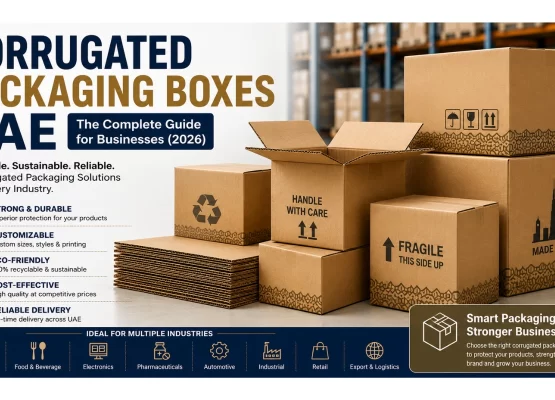
Corrugated Packaging Boxes UAE: The Complete.
Introduction Every product begins its journey long before it reaches the customer. During transportation, storage, warehouse.