 A smashed glass tabletop. A scratched cabinet door. A pallet of appliances that arrived dented. Every UAE business that ships products has lived some version of this story.
The fix is often simpler than people expect: a roll of corrugated paper.
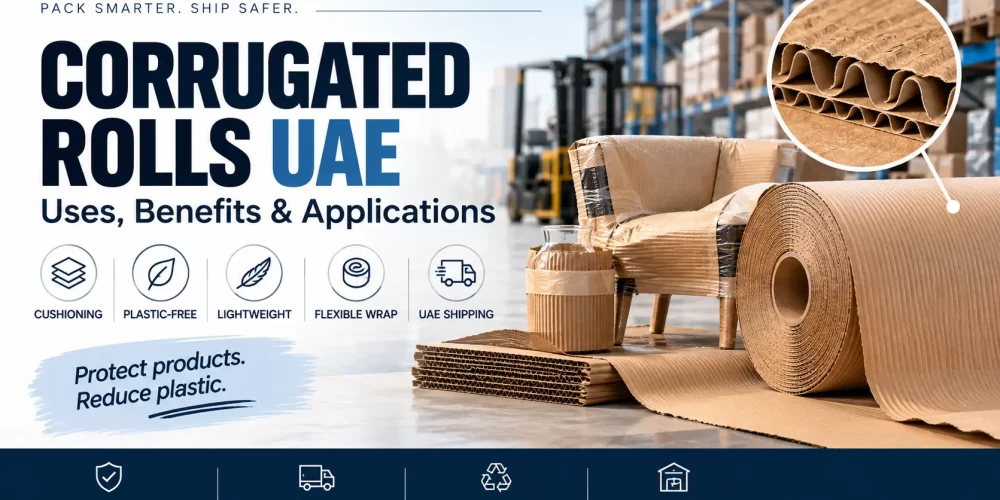
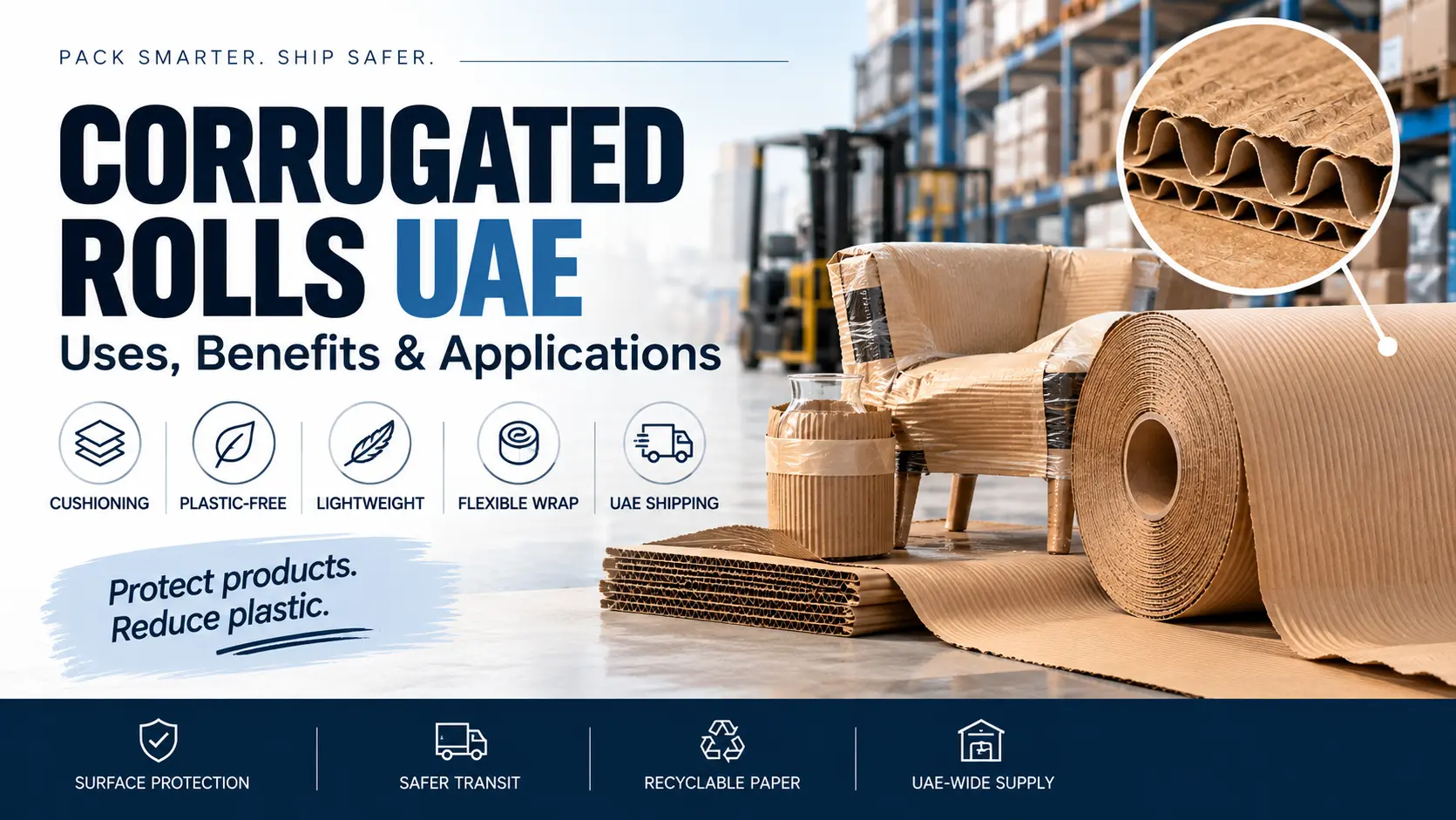
Corrugated rolls wrap, cushion and separate products without the plastic. They are light, flexible and easy to cut on the packing bench. Across Dubai, Sharjah and Abu Dhabi, they are replacing bubble wrap and foam in furniture workshops, warehouses and e-commerce fulfilment centres.
This guide covers what they are, why they work, where to use them and how to choose the right one for UAE conditions.
What Is a Corrugated Roll?
A corrugated roll is a continuous length of corrugated paper wound onto a core. You may also see it called a corrugated paper roll, corrugated wrap roll, corrugated cardboard roll or corrugated card roll. In day-to-day trade talk, many buyers just ask for cardboard rolls.
The most common type is single-face (2-ply) corrugated. It has two layers:
- A flat kraft paper liner on one side.
- A wavy, fluted layer glued to that liner.
The flutes are small arches. Each one acts like a tiny shock absorber. When a knock lands on the wrapped product, the flutes flex and spread the force instead of passing it straight through.
Because only one side has a liner, the roll bends easily. You can wrap it around a chair leg, a vase or a pipe, then tape it in place. A double-face sheet cannot do that. That flexibility is the whole point.
You can see the range available in the Al Mufeed corrugated rolls service page.
A quick note on terms. Corrugated plastic rolls are a different product. They are made from polypropylene and are used for signage, floor protection and some reusable packaging. This article is about corrugated brown paper rolls made from kraft paper, which are fully paper-based.
Key Benefits of Corrugated Rolls
1. Strong Cushioning and Vibration Control
The fluted structure absorbs impact and dampens vibration during transit. That matters on UAE routes where goods may travel by truck, sit in a port yard, then move again by van.
Wrap a product in two or three layers and you get a protective shell that holds its shape. Bubble wrap can pop or flatten. Corrugated keeps its structure.
2. A Plastic-Free, Recyclable Material
Kraft corrugated is paper. It can go into standard paper recycling streams once it is clean and dry.
That makes it a practical eco-friendly corrugated paper roll option for businesses trying to cut plastic use. If sustainability is on your procurement checklist, read our guide to sustainable packaging in the UAE and our piece on how cardboard supports a circular economy.
3. Lightweight, So Shipping Costs Stay Down
Carriers charge by weight or by volume, whichever is higher. A paper wrap adds very little weight. It also packs flat on the roll, so it uses less storage space than pre-formed foam inserts.
If you are trying to trim spend across the whole packing line, see how to reduce packaging costs.
4. Cut to Any Length
Need 40 cm for a lamp base? Or 3 metres for a sofa arm? Pull and cut. There is no need to stock ten different sizes of sleeve or pad.
This is useful for businesses that pack mixed items every day. One roll covers many jobs.
5. Fits Odd Shapes
Foam blocks and rigid boxes struggle with irregular items. A corrugated roll wraps around curves, corners and protruding parts. Fold it over twice at the edges for extra protection where damage usually happens.
6. Looks Professional
Brown kraft wrap has a clean, natural finish. When a customer unboxes a product wrapped in neat paper instead of loose plastic, it signals care. For premium furniture, glassware and décor, that matters.
Corrugated Rolls vs Bubble Wrap vs Foam
Buyers often ask how corrugated compares with the usual alternatives. Here is a practical comparison. Ratings are general guidance, not lab results. Actual performance depends on the product, flute size and paper weight.
| Feature | Corrugated Roll | Bubble Wrap | Foam Sheet |
| Impact protection | Good to very good | Good for light items | Very good |
| Surface and scratch protection | Very good (smooth liner inside) | Fair | Good |
| Recyclability | Paper recycling | Often not accepted | Rarely recycled |
| Plastic-free | Yes | No | No |
| Shape retention | Holds its form | Can deflate or pop | Holds its form |
| Heat behaviour | Stable, but avoid moisture | Can soften in high heat | Generally stable |
| Storage space | Compact | Bulky | Bulky |
| Best for | Furniture, glass, appliances, pipes, void fill | Small electronics, light items | Sensitive electronics, high-value items |
The takeaway: corrugated rolls do not replace foam for every job. For delicate electronics or precision parts, foam may still be the right call. But for the large majority of everyday protective packing, corrugated is strong enough, cheaper to handle and better for your plastic footprint.
Some customers also pair them. They use a corrugated wrap for outer protection and a thin layer of soft material against the product itself. If you need both, browse our adhesive tapes, stretch film and bubble roll range.
Understanding Flute Profiles and Paper Weight
Not all rolls perform the same. Two specifications matter most: the flute profile and the paper weight (GSM).
Flute Profile
The flute is the wave inside the paper. Different heights suit different jobs.
- A-flute (about 4.8 mm): The tallest common flute. It gives the most cushioning. Choose it for heavy furniture, machinery parts and items that need maximum shock absorption.
- B-flute (about 3 mm): The all-rounder. B flute cardboard rolls wrap well, resist crushing and print and cut cleanly. They suit general wrapping, interleaving and box lining.
- E-flute (about 1.5 mm): The thinnest. It is flatter and smoother, best for light products and neat, close wrapping.
Rule of thumb: the heavier or more fragile the item, the taller the flute. The more you need a tight, tidy wrap, the shorter the flute.
Paper Weight (GSM)
GSM tells you how heavy the paper is per square metre. Higher GSM means stronger, stiffer paper that resists tearing and holds up to rough handling. Lower GSM means lighter weight and a lower cost per metre.
For general packing, a mid-range kraft grade is usually enough. For export or long storage, go heavier.
Typical Roll Sizes
Widths commonly run from about 100 cm to 150 cm. Roll weight and length vary by supplier and flute type. A custom slit width is often available if your standard width wastes paper. Always confirm current sizes with your supplier before ordering.
Where Corrugated Rolls Are Used in the UAE
Furniture and Interior Joinery
The UAE’s furniture and fit-out trade moves a huge volume of tables, wardrobes, doors and cabinets. Industrial areas such as Al Quoz in Dubai and the Sharjah industrial zones are packed with workshops that need fast, affordable protection.
Corrugated rolls are a natural fit. Wrap panels and edges. Protect polished surfaces. Pad corners before loading. The smooth side prevents scuffing and the flutes absorb knocks.
Glass, Ceramics and Fragile Items
Glassware, mirrors, tiles and decorative pieces need cushioning on every side. Roll wrap forms a snug sleeve around each item. For heavier pieces, wrap twice and finish with a rigid outer carton.
For stronger outer packs, see our guides to corrugated box strength and single wall vs double wall corrugated boxes.
Electronics and Appliances
TVs, microwaves, air conditioners and small appliances travel in huge numbers. Corrugated rolls protect casings and corners, and wrap loose cables and accessories. For very sensitive internal components, combine with anti-static or foam inserts.
Automotive and Machinery Parts
Metal parts rub against each other in transit. A layer of corrugated between them stops scratches and dents. Wrap shafts, pipes, filters and panels before they go into crates or pallets.
Pallet Interleaving
Layers of cartons, bottles or tins on a pallet can slide or rub. Sheets of corrugated roll between layers add grip and protect the surface. This is common in food, beverage and building material logistics.
If you also need flat panels for layer pads or partitions, look at our corrugated cardboard sheets.
Void Fill and Box Lining
Empty space inside a carton is a risk. Items shift, hit the walls and break. Crumple or fold corrugated roll to fill gaps. Line the inside of a box for extra protection.
It is a tidy alternative to loose plastic fillers. And it uses the same material your customer will recycle with the box.
E-Commerce and Fulfilment
Online sellers across the UAE ship everything from candles to coffee tables. Corrugated rolls let packers adapt to each order without changing materials. For a full look at the topic, read our e-commerce packaging guide for the UAE.
If you ship in custom cartons, our custom corrugated boxes guide shows how to size the box so the roll wrap fits neatly inside.
Moving, Storage and Export
Removal companies and storage facilities use corrugated rolls to protect household goods. Exporters use them to protect cargo over long routes, where goods are handled many times.
How to Use Corrugated Rolls Correctly
Most damage happens because the roll is used the wrong way round. Follow these steps.
- Measure. Pull enough length to wrap the item at least twice, with a small overlap.
- Position the smooth side inward. The flat kraft liner should touch the product. It prevents scratches on polished wood, glass, painted metal and plastic.
- Keep the fluted side outward. The flutes face the outside, where they take the knocks. This is the crash-cushion layer.
- Wrap tightly, not too tightly. The roll should be snug but not crushing the flutes.
- Fold the corners. Add an extra layer at corners and edges, where most impacts land.
- Secure it. Use paper-based or BOPP tape, or stretch film for larger items. Learn more in our guide to BOPP tape in the UAE and how to choose the right adhesive packaging tape.
- Place in a carton or on a pallet. The roll protects the item. The outer pack carries the load.
Small exception: if you want maximum cushioning on a rough-handled product, you can wrap with the flutes both sides by doubling the layers. Always keep a smooth layer against delicate finishes.
Choosing the Right Roll for UAE Heat and Humidity
This is the part many suppliers skip, and it matters here.
UAE summers are hot. Coastal areas like Dubai and Abu Dhabi are also humid. Many warehouses and industrial units are not fully air-conditioned. Paper reacts to moisture. High humidity can soften the fibres, reduce stiffness and weaken the flutes over time.
Here is how to protect your stock.
- Store rolls off the floor. Use pallets or racks. Concrete floors can hold moisture.
- Keep them away from walls and open doors. Direct sun and damp air both cause problems.
- Stand rolls upright or keep them wrapped. Leave the original wrap on until use.
- Choose a higher GSM for long storage or sea export. Heavier paper holds its stiffness better.
- Use stock in rotation. First in, first out. Do not let rolls sit for months in a hot, damp unit.
- Keep finished packs dry in transit. For containerised export, consider moisture control inside the container.
These are simple habits, but they stop the quiet problem of weak, floppy wrap showing up in the peak season.
Sustainability and the UAE’s Green Direction
The UAE has set clear sustainability goals, including its Net Zero 2050 ambition, and has been moving to cut single-use plastics. Many large buyers, hotels, retailers and developers now ask suppliers about their materials.
Switching from plastic wrap to paper-based wrap is an easy step. You do not need to rebuild your process. You swap the material at the packing bench.
Corrugated rolls help in three ways:
- Less plastic in your outgoing packs.
- Recyclable at end of life, usually in the same stream as your cartons.
- Easy to report in procurement and ESG documents.
For wider context, see our overview of packaging materials in the UAE and the benefits of corrugated packaging.
Be realistic, though. Paper is only recyclable if it stays clean and dry. Heavy contamination from oil, food or wet adhesive can reduce recyclability.
Buying Corrugated Rolls in the UAE: What to Check
Before you place an order, run through this list.
- Roll width and length. Does it match your typical item size? Can the supplier slit to a custom width?
- Flute type. A, B or E? Match it to your heaviest or most fragile product.
- Paper grade and GSM. Ask for the specification, not just “strong”.
- Roll weight. Make sure your team can lift and handle it safely.
- Core size. Check it fits your dispenser or rack.
- Delivery. Confirm coverage across Dubai, Sharjah, Abu Dhabi, Ajman and the Northern Emirates, plus lead times for bulk orders.
- Consistency. Ask how the supplier controls quality from batch to batch.
- Add-ons. Check if they can supply tape, stretch film and cartons in the same order, so you only manage one vendor.
Sourcing locally also cuts lead time and helps you react fast when demand spikes. If you want to understand what to look for in a supplier, our guide on how to choose the best packaging company in the UAE is a good place to start. For a wider view, see our industrial packaging company overview.
Common Mistakes to Avoid
- Using the wrong side out. Always smooth side to the product.
- Under-wrapping. One thin layer rarely survives a long trip. Add layers for fragile items.
- Choosing flute by price alone. A cheaper roll that fails costs more than a better one.
- Ignoring storage. Humid storage ruins good paper.
- Skipping the outer carton. A roll protects the item, but the carton protects the roll.
- Over-taping. Too much tape makes recycling harder. Use only what you need.
Final Thoughts
Corrugated rolls are simple, but they solve real problems. They protect goods, cut plastic and fit nearly every product you can think of. In a market as busy and demanding as the UAE, that is a strong combination.
Pick the right flute. Use the smooth side in. Store the rolls properly. Do those three things and your damage rate will drop.
Ready to order or need advice on the right spec? Explore our full product range, browse our corrugated rolls page, or contact the Al Mufeed team for a quote and delivery across the UAE.
Frequently Asked Questions
Are corrugated rolls better than bubble wrap?
For many jobs, yes. They protect surfaces better, hold their shape and are easier to recycle. For small delicate electronics, bubble wrap or foam may still suit better.
What is the difference between a corrugated paper roll and a corrugated plastic roll?
A corrugated paper roll is made from kraft paper and is recyclable with paper. A corrugated plastic roll is made from polypropylene and is used for signage, floor protection and some reusable packs.
Which flute is best for furniture?
A-flute offers the most cushioning and suits heavier pieces. B-flute works for lighter furniture, flat panels and general wrapping.
Can corrugated rolls be used for export?
Yes. Use a higher GSM, wrap in extra layers and keep goods dry in the container.
Can I order a custom size?
Most suppliers can slit rolls to custom widths for larger orders. Confirm minimum order quantities and lead times first.

Single Wall vs Double Wall Corrugated.
Selecting the right corrugated packaging is essential for protecting products, reducing shipping costs, and improving customer.
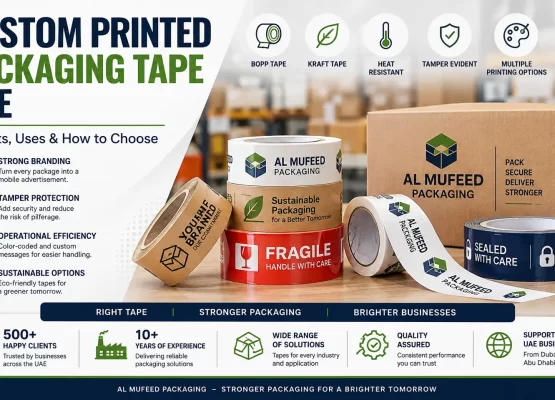
Custom Printed Packaging Tape UAE: Benefits,.
If you run an e-commerce brand, a warehouse, or an export business anywhere between Dubai, Sharjah,.