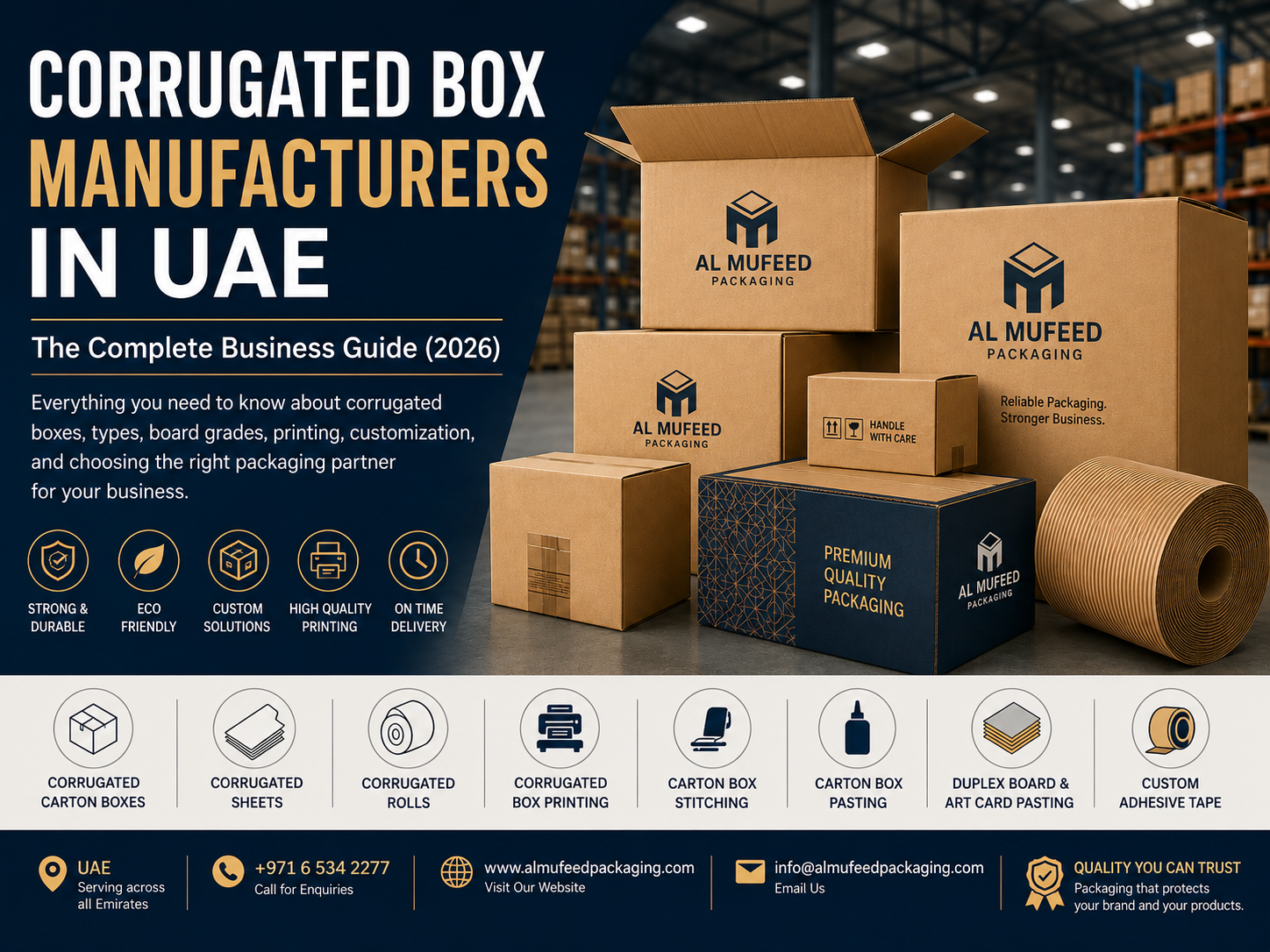
The UAE has become one of the world’s leading trade and logistics hubs, connecting businesses across the Middle East, Asia, Europe, and Africa. Every day, millions of products move through warehouses, manufacturing facilities, distribution centres, retail stores, and e-commerce fulfilment networks. At the centre of this supply chain is one packaging solution trusted by almost every industry: the corrugated box.
Whether you manufacture consumer goods, export products internationally, operate an online store, or distribute industrial equipment, your packaging directly affects product safety, transportation costs, warehouse efficiency, and customer satisfaction. A damaged shipment, poorly designed box, or unreliable supplier can increase costs and impact your brand’s reputation.
Businesses wanting a deeper technical understanding of corrugated packaging can refer to the Fibre Box Handbook, one of the industry’s most widely recognized technical resources.
This is why selecting the right corrugated box manufacturers in UAE is an important business decision rather than simply purchasing packaging materials.
Modern corrugated packaging is designed to do much more than protect products. It helps businesses improve logistics, create stronger brand recognition, reduce environmental impact, and deliver a better customer experience. From standard shipping cartons to custom printed retail packaging, corrugated boxes have evolved into an essential part of today’s supply chain.
This guide explains everything businesses should know before choosing a corrugated box manufacturer, including manufacturing processes, board grades, flute profiles, printing options, customization, sustainability, and industry-specific packaging solutions.
What is Corrugated Box?
Many people confuse corrugated boxes with ordinary cardboard boxes. Although they may appear similar, corrugated packaging is engineered differently to provide much greater strength and durability.
A corrugated box consists of three primary layers:
- Outer linerboard
- Corrugated fluted medium
- Inner linerboard
The fluted paper layer between the two linerboards creates thousands of small air pockets that absorb impact and distribute pressure evenly. This unique structure gives corrugated boxes their exceptional compression strength while keeping them lightweight.
Because of this design, corrugated packaging protects products against:
- Compression during stacking
- Shock during transportation
- Vibrations in transit
- Minor impacts
- Punctures
- Moisture exposure when paired with suitable coatings
Unlike many alternative packaging materials, corrugated boxes combine strength with low weight, making them one of the most economical packaging solutions available.
Why Corrugated Packaging Is Essential in the UAE
The UAE’s strategic location has transformed it into one of the busiest commercial centres in the region. Businesses regularly ship products within the country and export goods worldwide.
Packaging in this environment must perform under demanding conditions, including:
- Long-distance transportation
- Frequent loading and unloading
- Warehouse stacking
- Temperature variations
- Humidity changes
- International shipping regulations
Corrugated packaging has become the preferred choice because it offers the right balance of protection, cost efficiency, and sustainability.
Some of the key reasons businesses across Dubai, Sharjah, Abu Dhabi, Ajman, Ras Al Khaimah, Fujairah, and Umm Al Quwain rely on corrugated boxes include:
- Excellent structural strength
- Lightweight construction
- Lower transportation costs
- High customization potential
- Recyclable materials
- Efficient storage
- Professional product presentation
- Compatibility with automated packing systems
As e-commerce continues to grow in the UAE, demand for durable and customised corrugated packaging is expected to increase further.
How Corrugated Boxes Are Manufactured
Understanding the manufacturing process helps businesses appreciate the quality differences between suppliers.
Step 1: Paper Selection
Manufacturing begins with high-quality kraft paper or recycled paper. The paper’s strength, thickness, and composition determine the durability of the final box.
Different grades are selected depending on the intended application, such as lightweight retail packaging or heavy-duty industrial shipping.
Step 2: Corrugating Process
The paper passes through heated corrugating rollers that create the distinctive wave-shaped flutes.
These flutes are the primary source of the box’s strength.
The flute height and spacing vary depending on the required performance characteristics.
Step 3: Bonding
The corrugated medium is bonded between linerboards using specialised adhesives.
The result is a rigid corrugated board capable of supporting substantial loads while remaining lightweight.
Step 4: Cutting and Creasing
Large corrugated sheets are cut into specific dimensions.
Creasing lines are added to ensure the boxes fold accurately during assembly.
Step 5: Printing
Depending on customer requirements, manufacturers apply:
- Company logos
- Product details
- Handling instructions
- Barcodes
- QR codes
- Branding elements
- Promotional graphics
Modern printing technologies allow businesses to transform packaging into an extension of their marketing strategy.
Step 6: Die Cutting and Finishing
For custom packaging, specialised dies create unique shapes, inserts, handles, windows, and structural features.
This process enables manufacturers to produce packaging tailored to individual products rather than relying solely on standard box sizes.
Types of Corrugated Boxes
Every product has unique packaging requirements. Choosing the correct box style improves protection, reduces shipping costs, and enhances customer experience.
Regular Slotted Container (RSC)
The Regular Slotted Container is the most common corrugated box used worldwide.
Its simple construction makes it cost-effective while providing excellent strength for general shipping and storage.
Typical applications include:
- Consumer goods
- Warehouse storage
- FMCG products
- Industrial supplies
- Distribution centres
Half-Slotted Containers
These boxes are supplied without one set of flaps and are often paired with separate lids.
Common uses include:
- Bulk storage
- Retail display
- Industrial components
Full Overlap Boxes
In full overlap boxes, the top and bottom flaps completely overlap each other.
This design increases stacking strength and provides additional protection for heavier products.
Recommended for:
- Machinery parts
- Heavy equipment
- Glass products
- Automotive components
Die-Cut Boxes
Die-cut packaging is manufactured using customised cutting dies to match product dimensions precisely.
Benefits include:
- Improved presentation
- Better product fit
- Reduced movement during transport
- Lower need for void-fill materials
Industries commonly using die-cut packaging include:
- Electronics
- Cosmetics
- Luxury products
- Food packaging
- Promotional packaging
Mailer Boxes
Mailer boxes have become increasingly popular due to the rapid growth of online shopping.
They offer:
- Attractive presentation
- Easy assembly
- Enhanced customer experience
- Secure shipping
Common applications include:
- E-commerce
- Subscription boxes
- Fashion products
- Beauty products
- Consumer electronics
Heavy-Duty Corrugated Boxes
Heavy-duty boxes use thicker board grades and stronger flute combinations to carry substantial loads.
These boxes are suitable for:
- Export shipments
- Industrial machinery
- Construction materials
- Automotive parts
- Engineering equipment
Printed Corrugated Boxes
Printed packaging has become an important branding tool.
Businesses can customise boxes with:
- Brand colours
- Product information
- Marketing messages
- Safety instructions
- QR codes
- Social media details
High-quality printing transforms packaging into an effective communication channel while improving customer recognition.
Understanding Corrugated Board Grades
One of the biggest mistakes businesses make when purchasing corrugated boxes is assuming that every box offers the same level of protection. In reality, the strength of a corrugated box depends largely on its board grade and flute profile.
Selecting the correct board construction helps reduce product damage, optimize packaging costs, and improve shipping efficiency.
Single Face Board
Single face board consists of one linerboard attached to a fluted medium.
It is commonly used as protective wrapping rather than a standalone shipping box.
Applications
- Furniture protection
- Glass products
- Industrial components
- Surface cushioning
Single Wall Board
Single wall board includes two linerboards with one fluted medium between them.
It is the most commonly used corrugated board for everyday shipping.
Best suited for
- Retail packaging
- E-commerce
- FMCG products
- Consumer electronics
- Food packaging
Double Wall Board
Double wall board contains three linerboards and two fluted layers.
This construction significantly increases compression strength and impact resistance.
Recommended for
- Heavy machinery
- Automotive parts
- Industrial equipment
- Export shipments
- Large appliances
Triple Wall Board
Triple wall board combines four linerboards with three fluted mediums.
It offers exceptional strength and can often replace wooden crates in many industrial applications.
Ideal for
- Heavy industrial products
- Export cargo
- Construction materials
- Large engineering equipment
Corrugated Board Comparison
| Board Type | Strength | Weight Capacity | Common Applications |
|---|---|---|---|
| Single Face | Low | Very Light | Protective wrapping |
| Single Wall | Medium | Light to Medium | General shipping |
| Double Wall | High | Heavy | Industrial packaging |
| Triple Wall | Very High | Very Heavy | Export & heavy machinery |
Understanding Corrugated Flute Profiles
The flute is the wave-shaped paper layer between the linerboards. Its height and spacing determine the cushioning, compression strength, and print quality of the finished box.
Choosing the correct flute profile ensures that packaging matches the product’s weight and transportation requirements.
A Flute
A Flute provides excellent cushioning because of its taller wave profile.
Advantages
- Superior shock absorption
- Strong stacking strength
- Good protection for fragile products
Commonly used for:
- Glass products
- Ceramics
- Delicate industrial equipment
B Flute
B Flute has smaller, denser waves that improve puncture resistance.
It is often selected for retail packaging.
Suitable for:
- Food packaging
- Canned goods
- Retail products
- Die-cut boxes
C Flute
C Flute is the most widely used flute profile worldwide.
It provides an excellent balance between cushioning and stacking strength.
Applications include:
- Shipping cartons
- General packaging
- Consumer products
- Warehouse storage
E Flute
E Flute is thinner than traditional flute profiles.
Its smooth surface makes it ideal for premium printing.
Common applications:
- Cosmetics
- Electronics
- Luxury products
- Branded retail packaging
F Flute
F Flute is an ultra-thin corrugated board designed primarily for premium retail packaging.
Benefits include:
- Excellent print quality
- Lightweight construction
- Attractive presentation
Flute Comparison Table
| Flute Type | Cushioning | Print Quality | Typical Use |
|---|---|---|---|
| A Flute | Excellent | Moderate | Fragile products |
| B Flute | Good | Good | Retail packaging |
| C Flute | Excellent | Good | Shipping cartons |
| E Flute | Moderate | Excellent | Premium packaging |
| F Flute | Moderate | Outstanding | Luxury packaging |
Which Industries Use Corrugated Boxes?
Corrugated packaging is one of the most versatile packaging materials available. Its adaptability makes it suitable for almost every commercial sector.
Food and Beverage Industry
Food manufacturers require packaging that protects products throughout transportation while maintaining hygiene and presentation.
Corrugated packaging is commonly used for:
- Fresh produce
- Packaged foods
- Beverage cartons
- Bakery products
- Frozen foods
Benefits include:
- Lightweight transportation
- Ventilation options
- Easy stacking
- Recyclability
E-commerce
Online shopping has significantly increased the demand for durable corrugated packaging.
Every shipment must arrive safely while also creating a positive customer experience.
E-commerce businesses use corrugated boxes for:
- Clothing
- Electronics
- Cosmetics
- Home décor
- Subscription boxes
Custom printed mailer boxes have become especially popular because they reinforce brand identity during the unboxing experience.
Electronics Industry
Electronic products require protection against impact, vibration, and handling during transportation.
Corrugated packaging is often combined with:
- Foam inserts
- Cardboard dividers
- Protective sleeves
- Die-cut inserts
This combination reduces the risk of product damage.
Pharmaceutical Industry
Medical products require secure and reliable packaging.
Corrugated boxes are used for:
- Medical devices
- Medicines
- Healthcare supplies
- Laboratory equipment
Many pharmaceutical manufacturers also use custom inserts to prevent movement during transportation.
FMCG Industry
Fast-moving consumer goods require efficient packaging for storage, transportation, and retail distribution.
Corrugated boxes support:
- High-volume shipping
- Automated packaging lines
- Retail shelf replenishment
- Warehouse operations
Automotive Industry
Automotive manufacturers frequently transport heavy and irregularly shaped components.
Corrugated packaging protects:
- Spare parts
- Engine components
- Electrical systems
- Accessories
Heavy-duty double wall and triple wall boards are commonly used.
Industrial Manufacturing
Manufacturers use corrugated packaging for:
- Machine components
- Engineering products
- Construction materials
- Industrial tools
Custom-designed boxes improve product safety while reducing shipping costs.
How to Choose the Right Corrugated Box
Not every corrugated box is suitable for every application. Businesses should evaluate several factors before placing an order.
Businesses should also look for manufacturers operating under recognized quality management systems, such as ISO 9001.
Product Weight
Heavier products require stronger board grades.
Product Dimensions
A properly sized box minimizes movement during transportation and reduces the need for excess filler materials.
Shipping Distance
International shipments often require stronger corrugated boards than local deliveries.
Storage Conditions
Products stored in warehouses for extended periods require higher compression strength.
Fragility
Glass, electronics, and medical equipment often require additional cushioning or custom inserts.
Branding Requirements
If packaging plays a role in marketing, premium printing and customized box designs should be considered.
Sustainability Goals
Businesses aiming to reduce environmental impact should choose recyclable materials and optimized packaging designs.
Buyer Checklist Before Choosing a Corrugated Box Manufacturer
Before selecting a supplier, ask these questions:
- Does the manufacturer produce corrugated boxes in-house?
- Can they customize sizes and designs?
- Do they offer flexographic or offset printing?
- What board grades are available?
- Can they handle bulk production?
- What are their lead times?
- Do they provide prototypes or samples?
- Are sustainable materials available?
- Can they support future business growth?
Evaluating these factors helps businesses choose a packaging partner capable of delivering consistent quality and long-term value.
Custom Corrugated Packaging Solutions
Modern businesses rarely rely on standard packaging alone. Products differ in size, weight, fragility, and branding requirements, making custom corrugated packaging a practical investment rather than a luxury.
A reliable corrugated box manufacturer in UAE should be able to design packaging that protects products, reduces shipping costs, and enhances the customer experience.
Custom corrugated boxes are widely used across retail, e-commerce, pharmaceuticals, food manufacturing, electronics, logistics, and industrial sectors because they provide the right balance of functionality and brand presentation.
Size Customization
Every product deserves packaging that fits correctly.
Oversized boxes increase shipping costs, require additional void-fill materials, and allow products to move during transit. Undersized boxes can damage products and make packing inefficient.
Manufacturers can produce boxes in virtually any dimension to ensure an optimal fit.
Benefits include:
- Reduced material waste
- Lower shipping costs
- Better product protection
- Improved warehouse efficiency
Structural Customization
Beyond dimensions, businesses can customize the box structure based on the product’s requirements.
Popular options include:
- Die-cut boxes
- Mailer boxes
- Display boxes
- Partition boxes
- Folding cartons
- Export cartons
- Heavy-duty shipping boxes
The right structure improves both protection and ease of handling.
Custom Inserts
Fragile or premium products often require additional internal support.
Manufacturers can design inserts using:
- Corrugated partitions
- Die-cut cardboard inserts
- Honeycomb inserts
- Layer pads
- Protective sleeves
These inserts minimize movement and reduce the risk of damage during transportation.
Branding and Visual Identity
Packaging is often the first physical interaction customers have with a brand.
Custom printed corrugated boxes allow businesses to include:
- Company logos
- Brand colours
- Product information
- QR codes
- Social media handles
- Promotional messages
- Handling instructions
Well-designed packaging enhances brand recognition while creating a professional customer experience.
Printing Technologies for Corrugated Boxes
Printing quality plays a major role in retail packaging and brand presentation.
Professional manufacturers typically offer multiple printing methods depending on production volume, design complexity, and budget.
Flexographic Printing
Flexographic printing is the most widely used method for corrugated packaging.
Advantages
- Cost-effective for bulk production
- Fast printing speed
- Suitable for large orders
- Consistent print quality
Ideal for:
- Shipping cartons
- FMCG packaging
- Industrial boxes
Offset Printing
Offset printing delivers premium-quality graphics with sharp colours and fine detail.
Recommended for:
- Luxury packaging
- Retail products
- Cosmetics
- Consumer electronics
Although more expensive than flexographic printing, offset printing creates a premium appearance that supports brand positioning.
Digital Printing
Digital printing is increasingly popular for businesses requiring shorter production runs.
Benefits include:
- Quick turnaround
- No printing plates required
- Easy artwork changes
- High-resolution graphics
Digital printing is particularly useful for promotional campaigns, seasonal packaging, and prototype development.
Sustainable Corrugated Packaging
Sustainability has become a key consideration for businesses across the UAE.
Consumers increasingly prefer environmentally responsible brands, while many organizations have established sustainability goals to reduce their environmental footprint.
Many corrugated packaging manufacturers source paper from responsibly managed forests certified by the Forest Stewardship Council (FSC).
Corrugated packaging supports these objectives because it is made primarily from paper-based materials and can be recycled multiple times.
Environmental Benefits
Corrugated packaging offers several sustainability advantages:
- Recyclable materials
- Renewable resources
- Biodegradable composition
- Lightweight transportation
- Reduced carbon emissions
- Lower material waste
Many manufacturers also use recycled paper in production without compromising packaging performance.
Supporting Circular Economy Practices
A well-designed corrugated box can be collected, recycled, and converted into new packaging materials.
This circular process helps reduce landfill waste while conserving natural resources.
Businesses adopting recyclable packaging demonstrate environmental responsibility while meeting changing customer expectations.
Common Mistakes Businesses Make When Buying Corrugated Boxes
Selecting packaging based solely on price can lead to higher long-term costs.
Understanding these common mistakes helps businesses avoid unnecessary expenses and product damage.
Choosing the Wrong Board Grade
Boxes that are too weak may collapse during transportation, while unnecessarily strong boards increase packaging costs.
Selecting the correct board grade ensures an appropriate balance between strength and cost.
Ignoring Product Dimensions
Using oversized boxes increases shipping charges and requires additional protective materials.
Custom-sized packaging improves efficiency while reducing logistics costs.
Overlooking Printing Quality
Poor print quality affects brand perception.
Businesses using retail or e-commerce packaging should prioritize clear, consistent, high-quality printing.
Not Testing Packaging
Before placing large production orders, businesses should evaluate sample boxes under real shipping conditions.
Prototype testing helps identify structural improvements before full-scale manufacturing begins.
Selecting a Supplier Without Manufacturing Capability
Some suppliers act only as distributors.
Working directly with an experienced manufacturer often provides:
- Better quality control
- Faster production
- Greater customization
- Competitive pricing
- Reliable technical support
Future Trends in Corrugated Packaging
Packaging continues to evolve alongside advances in manufacturing, logistics, and consumer expectations.
Businesses planning long-term packaging strategies should understand these emerging trends.
Smart Packaging
QR codes, RFID labels, and digital tracking technologies are making packaging more interactive and traceable.
These features improve inventory management and customer engagement.
Sustainable Innovation
Demand for environmentally responsible packaging continues to grow.
Manufacturers are investing in:
- Recycled materials
- Lightweight board designs
- Water-based inks
- Reduced material consumption
Automation
Automated production lines improve consistency while increasing manufacturing efficiency.
Automation also enables faster turnaround times for large production volumes.
Digital Printing Growth
Digital printing allows businesses to personalize packaging, reduce setup costs, and launch short-run marketing campaigns more efficiently.
E-commerce Expansion
As online retail continues to grow throughout the UAE, demand for durable, attractive, and cost-effective corrugated packaging will continue to increase.
Packaging designed specifically for courier networks and home deliveries will become even more important.
Why Choose Al Mufeed Packaging?
Choosing the right packaging partner is about more than purchasing boxes. It is about working with a manufacturer that understands your products, industry requirements, and business goals.
At Al Mufeed Packaging, we provide high-quality corrugated packaging solutions designed to meet the needs of businesses across the UAE.
Our product range includes:
- Corrugated Carton Boxes
- Die-Cut Boxes
- Corrugated Cardboard Sheets
- Corrugated Rolls
- Printed Corrugated Boxes
- Duplex Board & Art Card Pasting
- Box Stitching & Pasting
- Custom Adhesive Tape
Why businesses choose us:
- Modern manufacturing facility
- Custom packaging solutions
- High-quality printing capabilities
- Consistent product quality
- Flexible production volumes
- Timely delivery across the UAE
- Experienced technical support
- Customer-focused service
Whether you need standard shipping cartons or fully customized packaging, our team works closely with you to deliver solutions that protect your products and support your business growth.
Frequently Asked Questions
What is a corrugated box?
A corrugated box is a paper-based packaging solution made with one or more fluted layers between linerboards, providing strength, cushioning, and durability.
Why are corrugated boxes preferred for shipping?
They are lightweight, strong, cost-effective, and provide excellent protection against impacts during storage and transportation.
Which industries use corrugated packaging?
Corrugated packaging is widely used in food and beverage, retail, e-commerce, pharmaceuticals, electronics, automotive, manufacturing, and logistics.
What is the difference between cardboard and corrugated board?
Cardboard is typically a single-layer paperboard, while corrugated board contains a fluted layer between linerboards, making it much stronger and more durable.
Can corrugated boxes be customized?
Yes. Manufacturers can produce custom sizes, shapes, structural designs, inserts, and printed branding to suit specific products and industries.
Are corrugated boxes environmentally friendly?
Yes. Most corrugated boxes are recyclable, biodegradable, and manufactured using renewable paper-based materials.
Which flute type is best?
The ideal flute depends on the application. C Flute is commonly used for shipping cartons, while E Flute is preferred for premium retail packaging due to its smooth printing surface.
How long does it take to manufacture custom corrugated boxes?
Production timelines vary based on design complexity, order quantity, and printing requirements. Your manufacturer can provide an estimated lead time after reviewing your specifications.
Can corrugated boxes be printed with company branding?
Yes. Corrugated boxes can include logos, graphics, handling instructions, QR codes, and promotional messaging using flexographic, offset, or digital printing.
How do I choose the right corrugated box manufacturer in the UAE?
Look for a manufacturer with proven experience, in-house production capabilities, customization options, quality control processes, reliable delivery schedules, and responsive customer support.
Conclusion
Corrugated packaging has become an essential part of modern supply chains, offering businesses a reliable, cost-effective, and sustainable solution for protecting products during storage and transportation.
Choosing the right corrugated box manufacturer in the UAE involves more than comparing prices. It requires evaluating manufacturing expertise, product quality, customization capabilities, printing technology, production capacity, and long-term support.
By understanding board grades, flute profiles, box styles, printing methods, and industry requirements, businesses can make informed decisions that improve operational efficiency, reduce shipping damage, and strengthen their brand.
If your business is looking for dependable corrugated packaging solutions, Al Mufeed Packaging provides custom manufacturing, high-quality printing, and reliable service to help businesses across the UAE package, protect, and present their products with confidence.

Industrial Adhesive Tape UAE: Types, Applications.
Industrial adhesive tape is an essential solution for businesses that need reliable bonding, sealing, mounting, protection,.
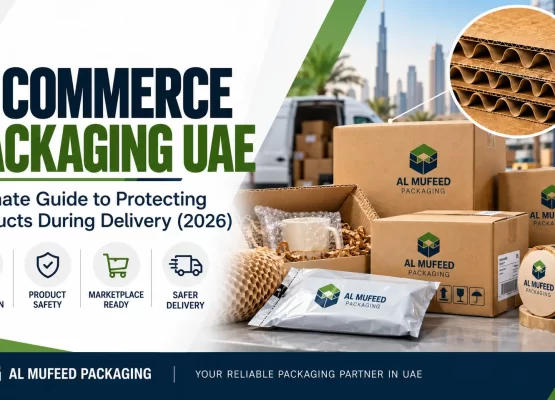
E-Commerce Packaging in the UAE: The.
E-Commerce Packaging in the UAE: The Ultimate Guide to Protecting Products During Delivery (2026) Dubai's summer.