
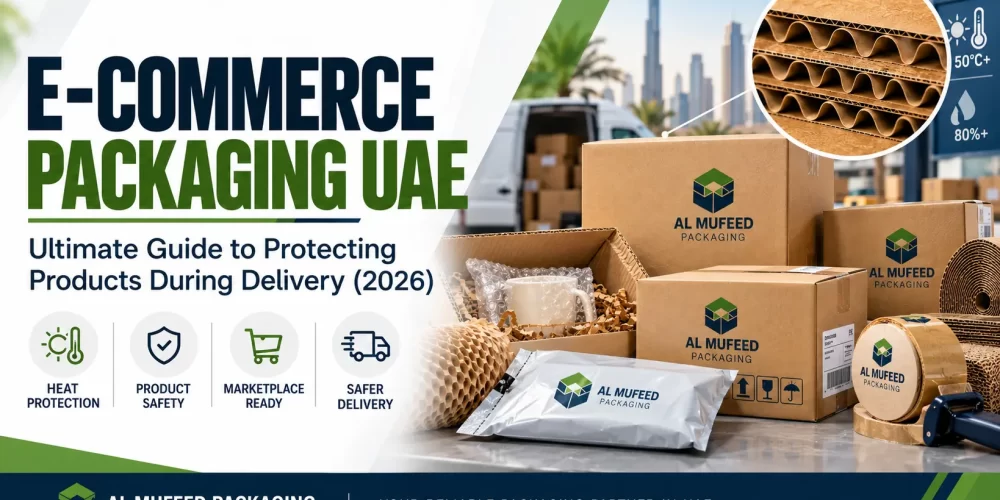
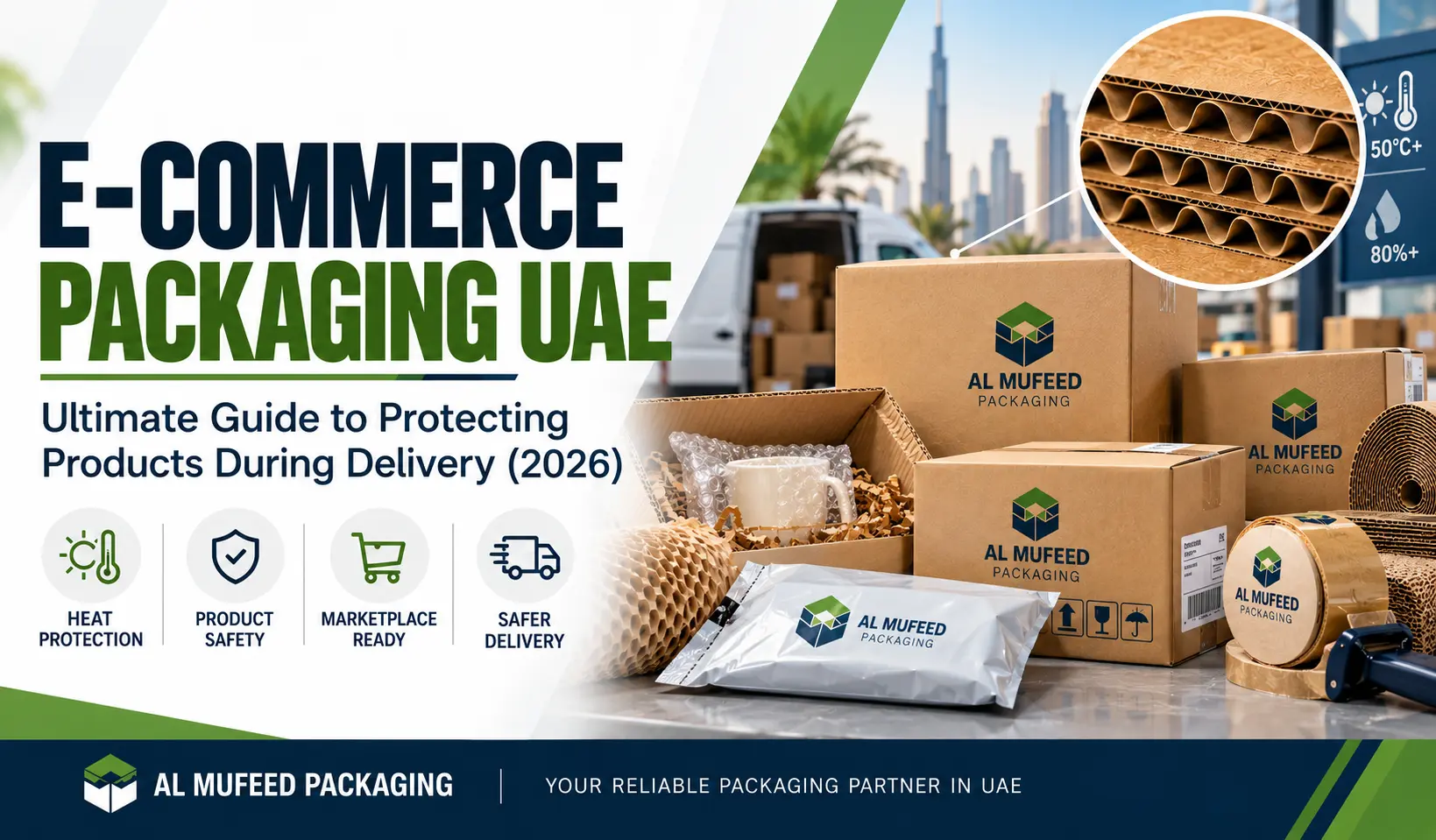
E-Commerce Packaging in the UAE: The Ultimate Guide to Protecting Products During Delivery (2026)
Dubai’s summer asphalt gets hot enough to warp a chocolate bar in under ten minutes. That single fact should change how every online seller in the UAE thinks about packaging.
Most “ultimate guides” to e-commerce packaging read like they were written for Ohio, then copy-pasted for the Gulf. They’ll tell you to use bubble wrap and call it a day. They won’t tell you that standard adhesive tape fails at 45°C, that Noon and Amazon.ae reject shipments for missing Arabic warning labels, or that a parcel crossing into Saudi Arabia gets handled — and dropped — far more times than one delivered across town.
This guide fixes that. It’s built specifically for sellers shipping from and within the UAE, covering the product-risk basics every competitor mentions, plus the regional realities most of them skip entirely.
The UAE Delivery Environment: Heat, Humidity, and Last-Mile Reality
Before picking a single box or roll of tape, understand what your parcel actually goes through.
A typical delivery van in Dubai or Sharjah can hit interior temperatures well above 50°C during summer months, even with air conditioning cycling on and off between stops. Combine that with 80%+ humidity along the coast, and you get two very specific failure modes:
- Adhesive breakdown. Standard rubber-based tape softens and peels under sustained heat, causing boxes to pop open mid-transit.
- Product degradation. Chocolates, cosmetics, candles, and certain skincare items can melt, separate, or discolor before they ever reach the doorstep.
What this means for your e commerce packaging strategy:
- Switch to heat-resistant acrylic or hot-melt adhesive tapes rather than generic packing tape — see this breakdown on how to choose the right adhesive packaging tape for UAE conditions.
- Add moisture-absorbing desiccant sachets for humidity-sensitive goods.
- Use thermal or foil-lined liners for temperature-sensitive cosmetics and confectionery.
- Consider temperature-indicator strips on high-value, heat-vulnerable shipments so you have proof of mishandling if a return dispute comes up.
Ignore this step and you’ll pay for it in refunds, not just reviews.
Best Ecommerce Packaging by Product Risk: A UAE-Ready Framework
Not every product needs the same box. The best ecommerce packaging approach starts by sorting your catalog into risk tiers, then matching materials to each one.
Low-risk (durable, non-fragile):
- Apparel, books, accessories
- Poly mailers or lightweight corrugated boxes work fine
- Focus on right-sizing to control shipping cost, not over-protection
Medium-risk (moderately fragile or valuable):
- Electronics, small appliances, footwear
- Double-wall corrugated boxes with void-fill cushioning
- Anti-static bags for anything with circuitry
High-risk (fragile, liquid, or high-value):
- Glassware, ceramics, cosmetics, perfumes, liquids
- Double-boxing (box-in-a-box) with center placement
- Leak-proof, upright-only packing for liquids
- Foam inserts or molded cushioning for anything breakable
Building this framework into your packing process — rather than eyeballing it per order — is what separates professional operations from sellers who guess and hope. If you’re sourcing at scale, corrugated packaging boxes made for UAE conditions already account for local handling stresses that imported stock often doesn’t.
Outer vs. Inner Protection: Ecommerce Packaging Design That Actually Holds Up
This is the technical core of any protective strategy, and it’s where most sellers cut corners they shouldn’t.
Outer layer — the structural shield
- 3-ply corrugated is fine for light, low-value items.
- Double-wall (5-ply) is the safer default for most e-commerce parcels moving through multiple courier handoffs.
- Triple-wall (7-ply) is reserved for heavy or high-value shipments, or anything headed on a long-haul route.
Not sure which fits your product line? This comparison of single-wall vs. double-wall corrugated boxes breaks down strength-to-weight tradeoffs in plain terms.
Inner layer — the cushioning
- Honeycomb kraft paper and paper-based void fill are increasingly preferred over plastic air pillows, both for sustainability and because plastic cushioning underperforms in heat.
- Foam inserts for anything genuinely fragile.
- Always eliminate void space — a box that lets a product shift 3-4 cm during transit is a box that will arrive damaged.
Sealing — the part everyone gets wrong
- Use the H-taping method: seal the center seam, then reinforce both edge seams in an “H” pattern.
- Minimum 5cm tape width for anything over 2kg.
- Never rely on decorative or paper tape as structural sealing — it looks nice, it doesn’t hold.
Getting the right base materials matters more than any individual technique. A quick look at available packaging materials in the UAE will show you what’s realistically sourceable locally versus what you’d need to import.
Custom Ecommerce Packaging in the UAE: Branding Without Blowing Your Budget
Custom ecommerce packaging used to be a luxury reserved for big-budget brands. That’s no longer true — but it does need to be done strategically, especially with UAE shipping costs factored in.
Effective, cost-conscious branding options:
- Custom-printed mailer boxes or custom printed corrugated boxes with your logo pre-printed rather than stickered — cheaper at volume and looks more premium.
- Branded packaging tape instead of a fully custom box, if budget is tight.
- Tissue paper and thank-you inserts for a boutique unboxing feel at minimal per-unit cost.
- Bilingual inserts (Arabic and English) — this isn’t just a nice touch in the UAE, it’s often expected by local customers and required by some marketplaces.
The mistake to avoid: choosing custom packaging that adds bulk without adding protection. Custom packaging for ecommerce should always solve both problems — brand experience and product safety — at the same time, or it’s not earning its cost.
Eco-Friendly and Sustainable Ecommerce Packaging for the UAE Market
Demand for eco friendly ecommerce packaging is rising fast across UAE retail, driven partly by consumer expectation and partly by Dubai’s broader sustainability push. But “sustainable” and “flimsy” aren’t the same thing, and the UAE climate punishes flimsy packaging quickly.
Practical, durable sustainable choices:
- Honeycomb kraft paper as a void-fill replacement for plastic bubble wrap — biodegradable and surprisingly strong.
- Recycled corrugated board for outer boxes, sourced from suppliers who can confirm actual recycled content rather than just claiming it.
- Paper-based mailers for apparel and lightweight goods instead of plastic poly bags.
- Right-sized boxes — the single most underrated sustainability move, since it cuts both material waste and volumetric shipping weight simultaneously.
If sustainability is a core part of your brand positioning, it’s worth reviewing a dedicated resource on sustainable packaging in the UAE to see which certified materials are actually available locally versus which are marketing claims. Sustainable packaging ecommerce strategies that hold up under scrutiny will increasingly matter for both customer trust and, potentially, future regulation.
Marketplace Compliance: Amazon.ae, Noon, and Careem Box Packaging Rules
Here’s a gap almost every generic guide misses entirely: your packaging can get your listing suspended if it doesn’t meet marketplace-specific rules.
For Amazon.ae (FBA) and Noon (FBN) sellers, check for:
- Barcode visibility — scannable, unobstructed, and on the correct face of the box.
- Suffocation warnings printed in both English and Arabic on any polybag packaging.
- Maximum box dimensions per fulfillment center guidelines — oversized boxes get rejected or cost extra.
- Liquid seal requirements — double-bagged and leak-tested before boxing.
- No loose or exposed packaging tape edges, which fail automated inbound checks.
If you’re selling across multiple UAE marketplaces, build a compliance checklist per platform rather than assuming one packaging standard covers all of them. A shipment that’s perfectly packed for a direct-to-customer order can still get bounced back by an FBA warehouse for a labeling detail.
GCC Cross-Border Shipping: Packaging for Customs and Long-Haul Transit
Most competitor content treats “e-commerce delivery” as purely a Dubai-to-doorstep problem. If you’re shipping into Saudi Arabia, Oman, or Kuwait, that assumption will cost you damaged goods and customer complaints.
Cross-border GCC parcels face:
- Multiple handling points — customs inspection, cross-docking, and additional courier transfers each add impact risk.
- Longer transit times, meaning heat exposure compounds rather than being a single short van ride.
- Customs documentation requirements that sometimes mean re-opening and re-sealing packages.
Adjustments worth making for cross-border shipments:
- Upgrade to triple-wall corrugated for anything crossing a border, even if a single-market shipment would be fine in double-wall.
- Reinforce corners specifically — that’s where cross-docking damage concentrates.
- Use tamper-evident tape so re-sealing after customs inspection is visible and doesn’t void your quality guarantee.
Returns-Ready Packaging: Bilingual Unboxing and Reverse Logistics
Fashion and apparel returns are a significant cost center in UAE e-commerce, and almost no competing guide addresses packaging built for the return trip.
What actually helps:
- Dual-peel strip mailer bags — resealable without needing a whole new box, which speeds up returns processing and cuts material waste.
- Bilingual return instructions printed directly on an insert card, not buried in an email customers won’t find.
- Pre-printed return labels where volume justifies it, reducing customer friction and improving your return completion rate.
Packaging designed with returns in mind isn’t an afterthought — it’s a direct lever on customer satisfaction scores and repeat purchase rates.
Choosing an Ecommerce Packaging Company in the UAE: Sourcing and Cost Control
With dozens of ecommerce packaging companies operating across the Emirates, the right partner should offer more than a price list — they should understand your specific product risk profile and shipping routes.
What to evaluate:
- Local manufacturing versus imported stock — local production (from hubs like Sharjah’s industrial areas) usually means faster reorder turnaround and fewer supply chain surprises.
- Right-sizing capability — can they produce custom dimensions, or only standard sizes that leave you paying for wasted volumetric weight?
- Material transparency — can they confirm ply count, recycled content, and adhesive type, or are you taking their word for it?
On the cost side, the biggest lever most sellers underuse is volumetric weight optimization. Couriers charge based on box dimensions, not just actual weight — an oversized box for a small product quietly inflates every single shipment’s cost. This guide on reducing packaging costs walks through the math in more detail, and it’s worth revisiting quarterly as your product mix shifts.
Final Checklist for UAE E-Commerce Dispatch
Before a parcel leaves your warehouse, run it against this list:
- Product risk tier identified and matched to box strength
- Heat-resistant tape used, H-taping method applied
- Void space eliminated, appropriate cushioning added
- Desiccant included for humidity-sensitive items
- Marketplace-specific labeling checked (Amazon.ae / Noon)
- Bilingual warning and return labels included where required
- Cross-border shipments upgraded to reinforced packaging
- Box dimensions right-sized to control volumetric weight
Get these right consistently, and your damage rate — and your return rate — will drop faster than any single “premium” packaging upgrade ever could.
Building a packaging process this detailed usually means working with a supplier who already understands UAE shipping conditions rather than explaining them from scratch. If you’re evaluating options, Al Mufeed Packaging’s product range covers most of what’s referenced above, from corrugated boxes to adhesive tapes — or you can get in touch directly to talk through your specific product mix.
E-Commerce Packaging UAE: FAQ’s
What is the best packaging for e-commerce products in the UAE?
The best ecommerce packaging matches material to product risk — poly mailers for low-risk items, double-wall corrugated for electronics, and double-boxing with foam for fragile or liquid goods.
Why does my packaging tape fail during UAE summers?
Standard tape softens above 45°C. Switch to heat-resistant acrylic tape — a small fix that protects your entire e commerce packaging setup from mid-transit failures.
How do I stop products melting or spoiling in transit?
Use foil-lined liners, desiccant sachets, and temperature-indicator strips for heat-sensitive items like cosmetics and chocolate — essential ecommerce product packaging for the UAE climate.
What are Amazon.ae and Noon’s packaging requirements?
Scannable barcodes, bilingual (English/Arabic) suffocation warnings, correct box dimensions, and leak-tested liquid seals. Non-compliant e commerce packaging gets rejected at inbound checks.
Is custom packaging worth it for small UAE sellers?
Yes — custom packaging for ecommerce doesn’t require full custom boxes. Branded tape and bilingual inserts deliver brand impact at low cost.What’s the difference between 3-ply, 5-ply, and 7-ply corrugated boxes?
More plies mean more strength. 5-ply (double-wall) is the safe default; 7-ply suits heavy or cross-border ecommerce packaging design.
How do I make my packaging more sustainable without weakening it?
Swap plastic void-fill for honeycomb kraft paper and use recycled corrugated board — proven sustainable ecommerce packaging that still protects.
Does packaging affect my shipping cost?
Yes — couriers bill by box size, not just weight. Right-sizing is the fastest cost win in any e commerce packaging strategy.
What changes for GCC cross-border shipping?
Upgrade to triple-wall corrugated, reinforce corners, and use tamper-evident tape — cross-border transit is rougher than local delivery.
How should I package products likely to be returned?
Use resealable dual-peel mailer bags with bilingual return instructions — smart ecommerce product packaging cuts return friction and waste.
Where can I source packaging materials locally in the UAE?
Local hubs like Sharjah supply corrugated board and mailers fast. Choosing UAE-based ecommerce packaging companies cuts lead time versus importing.
How do I know if my packaging is too weak?
Track damage-related returns by product category. A rising damage rate signals it’s time to upgrade your sustainable packaging ecommerce materials or ply strength.

Food Delivery Packaging UAE: How to.
Food delivery has changed the way restaurants, cafés, cloud kitchens and catering businesses think about packaging..
Custom Printed Corrugated Boxes: How Packaging.
Packaging does more than protect products during transportation. It can also influence how customers perceive a.