The wrong packaging supplier rarely fails on day one. The problems show up later: a pallet of crushed cartons after a July shipment, tape that lets go in a 45°C warehouse, or a label rejected for missing Arabic text.
The UAE has hundreds of packaging material suppliers, from trading shops to full manufacturers. They look the same on a website and behave very differently when something goes wrong.
This guide shows you how to separate them. You’ll get a clear vetting process, honest price ranges, and the UAE-specific details most guides skip: heat, humidity, GCC customs and e-commerce returns.
Step 1: Know What You’re Actually Buying
“Packaging” covers very different products. Start by naming your category. It narrows the field fast.
- Corrugated shipping cartons: the workhorse of shipping packaging supplies and industrial packaging supplies.
- Die-cut and food boxes: pizza, cake, dates and Iftar boxes, and mailers.
- Adhesive tapes and films: BOPP tape, printed tape, stretch film and bubble roll.
- Rigid and gift boxes: cosmetics and premium retail.
- Raw materials: corrugated sheets, rolls and duplex board for your own converting.
A supplier strong in one category is often average in another. A glass-jar specialist won’t be your best source of heavy export cartons.
If you’re still mapping your options, start with this overview of packaging materials in the UAE.
Step 2: Decide Between a Trader and a Manufacturer
This is the biggest decision on the page.
Traders and shop-style suppliers are good for small, urgent orders. If you need to shop packaging supplies for a handful of cartons and a few tape rolls, they’re fast and flexible. You pay a markup, and you can’t control specs.
Manufacturers control the board, the printing and the finishing. You get tighter pricing at volume, custom sizes and traceable quality. The trade-off is minimum order quantities (MOQs) and longer lead times for new designs.
A simple rule:
- Under a few hundred units of standard items: a trader works.
- Recurring or custom orders: go to a manufacturer.
- Both: use a trader for emergencies and a manufacturer as your main source.
Our guide to packaging manufacturers in the UAE covers the difference in more detail.
Step 3: Check Location and Logistics
Freight adds up quickly, so where your supplier sits matters.
Most of the UAE’s carton and packaging production clusters in Sharjah, Ajman, Al Quoz and Deira. A supplier in Sharjah or Ajman gives you:
- Lower delivery costs to Dubai, Abu Dhabi and the Northern Emirates
- Faster reorders, often within the same week
- Easier factory visits before you commit
Ask every supplier two questions: where is the factory, and who delivers? A trading office in Dubai can sit on top of a factory in another country. That affects lead time more than any price quote will.
Step 4: Verify Certifications for Your Industry
Certificates aren’t decoration. Which ones you need depends on what goes inside the box.
| Your product | What to ask for |
| Food and beverage | Food-safe materials, HACCP, ISO 22000, BRCGS, Halal where relevant |
| Pharma and cosmetics | ISO 9001, traceability, batch documentation |
| General shipping | ISO 9001, consistent board specs |
| Export | Compliance with MoIAT requirements |
Don’t take a logo on a website as proof. Ask for the certificate, check the issue and expiry dates, and confirm it covers the actual factory that will make your product.
If you source food packaging supplies or work with food packaging companies, ask how they handle ink and coating migration. Printed surfaces that touch food need to be food-grade. Our post on food packaging boxes in the UAE covers this, and the custom food boxes guide covers the design side.
Step 5: Understand MOQs and Tooling Costs
Quotes confuse buyers mainly because of two hidden items.
Minimum order quantity. Manufacturers set MOQs because every print run needs machine setup. Low-MOQ suppliers exist, but unit prices are higher. Ask what the MOQ is per size and per design, not just overall.
Tooling and setup fees. Die-cut boxes need a cutting die. Printed boxes need plates. These are usually one-time costs, but they distort your first quote. Always ask for two numbers:
- The one-time tooling cost
- The unit price excluding tooling
Compare suppliers on the second number. Then decide whether the tooling fee is fair.
For more ways to cut spend without cutting quality, see reducing packaging costs.
Step 6: Use Real Price Benchmarks
Most supplier pages say “competitive pricing” and stop there. Here is what the market typically looks like.
These are indicative estimates for planning only. Actual prices depend on board grade, size, print coverage and current paper costs. Always get written quotes.
Standard brown corrugated carton (3-ply, medium size, unprinted)
| Quantity | Estimated price per unit (AED) |
| 100 units | 3.50 – 5.50 |
| 1,000 units | 2.20 – 3.50 |
| 10,000 units | 1.50 – 2.50 |
Custom printed die-cut box (1–2 colours)
| Quantity | Estimated price per unit (AED) |
| 100 units | 8.00 – 15.00 (plus die cost) |
| 1,000 units | 4.00 – 8.00 |
| 10,000 units | 2.50 – 5.00 |
What these ranges tell you:
- The biggest drop comes between 100 and 1,000 units. Setup costs spread out.
- Gains flatten after 10,000. Beyond that, negotiate on payment terms and delivery schedules rather than unit price.
- A quote far below the range is a warning. It usually means thinner board, lower-grade paper or hidden fees.
Step 7: Test for Heat and Humidity
Most packaging advice comes from cooler climates. UAE conditions are harsher, and ignoring them is expensive.
Heat. Summer warehouse and container temperatures can pass 45°C. Some adhesives soften, and tape can creep or release. Ask your supplier:
- What temperature range is the tape rated for?
- Is the adhesive hot-melt, acrylic or natural rubber? (Each behaves differently.)
- Can they supply samples for a heat test?
Humidity. Corrugated board absorbs moisture. As it does, compression strength drops, and stacked cartons slowly collapse. Coastal cities like Dubai, Sharjah and Abu Dhabi see this most in summer.
Practical fixes:
- Choose double-wall board for heavy or stacked goods. See single wall vs double wall boxes.
- Specify a moisture-resistant coating for humid storage.
- Store pallets off the floor and away from loading-bay doors.
A simple test: leave a sample carton loaded with weight in a hot, humid space for a week. If the walls bow, you’ve learned something cheaply. For more on board performance, read about corrugated box strength in the UAE.
Step 8: Pick the Right Board and Flute
If you buy from corrugated packaging companies, you’ll hear terms like B-flute and C-flute. Here’s what they mean:
- B-flute (about 3 mm): a thinner flute that is rigid, with a flatter surface that prints well. It suits retail boxes, food boxes and lighter goods.
- C-flute (about 4 mm): a thicker flute with better cushioning and stacking strength. It suits shipping cartons.
- Double-wall (BC): combines both for heavy, fragile or export loads.
Don’t over-specify. Heavier board costs more and raises freight weight. Don’t under-specify either. A box that fails costs far more than the saving.
Match the board to the product’s weight, fragility and stacking height. Our guides on corrugated box sizes help with sizing.
Step 9: Ask About Design, Sampling and Arabic Printing
A good supplier does more than quote. Look for:
- In-house design support: dielines, artwork checks and structural advice
- Fast prototyping: physical samples before the full run
- Bilingual printing: accurate Arabic and English text for labels and boxes
That last point matters for compliance and for customers. Always proof Arabic text with a native reader. Reversed or disconnected letters are a common printing error, and they look unprofessional.
Ask to see work from similar clients. For printing options, see custom printed corrugated boxes and custom printed packaging tape.
Step 10: Plan for GCC Distribution and Customs
If you sell beyond the UAE, packaging choices touch customs.
The GCC works as a customs union, so goods that have already paid duty at their first point of entry generally move more freely between member states. In practice, though, paperwork, VAT differences and product standards still apply. UAE VAT is 5%, while Saudi Arabia’s is 15%, for example.
Questions to ask your supplier and your customs broker:
- Do the packaging materials meet MoIAT and destination-country standards?
- Does the supplier give you the documents customs asks for (material declarations, certificates of origin)?
- Can they pack to export specs, such as heavier board, palletisation and moisture protection?
- How do they handle re-export or transfers from free zones?
Rules change, so confirm current requirements with a licensed customs broker before you ship. A good supplier will already know the common pitfalls.
Step 11: Design for E-Commerce Returns
Online sellers in the UAE face high return rates, and most boxes get used once. That wastes money.
Look for return-ready packaging:
- Double adhesive strips: one for the outbound seal, one for the return.
- Tear strips: easy for customers to open without a knife.
- Right-sized mailers: less void fill and lower courier charges.
- Printed return instructions: fewer customer service calls.
A resealable box costs a little more per unit. Compare that to buying a second box and a second shipment for every return. For more, read our e-commerce packaging guide.
Step 12: Ask About Sustainability
More UAE buyers, and more corporate clients, now ask for eco-friendly packaging. Corrugated is a strong option because it’s widely recyclable and often made with recycled content.
Ask suppliers about:
- Recycled-content percentage
- FSC or similar sourcing credentials
- Right-sizing to reduce material use
- Water-based inks
Be wary of vague “green” claims with no numbers behind them. See sustainable packaging in the UAE for what to look for.
Your Packaging Material Supplier Scorecard
Score each shortlisted supplier from 1 (poor) to 5 (excellent). Multiply by the weight, then add up.
| Criteria | Weight | Supplier A | Supplier B | Supplier C |
| Manufacturer or trader (control over spec) | ×3 | |||
| Relevant certifications verified | ×3 | |||
| Price transparency (tooling shown separately) | ×2 | |||
| MOQ fits your volumes | ×2 | |||
| Heat and humidity performance | ×3 | |||
| Sampling and design support | ×2 | |||
| Arabic and English printing | ×1 | |||
| Location and delivery speed | ×2 | |||
| Export and customs knowledge | ×1 | |||
| References from similar clients | ×2 |
Maximum score: 105.
- 85+: strong partner. Move to a trial order.
- 65–84: workable. Negotiate or request improvements.
- Under 65: keep looking.
A quick decision flow
- Is your order under 300 units of standard items? Yes: a trader or shop will do. No: continue.
- Do you need custom size, print or structure? Yes: shortlist manufacturers. No: compare standard stock and price.
- Does your product touch food, drugs or cosmetics? Yes: certifications come first. Eliminate any supplier who can’t show them.
- Will goods sit in heat, humidity or long transit? Yes: demand sample testing before the full order.
- Are you exporting within the GCC? Yes: confirm documentation and standards with the supplier.
- Run the scorecard on your final three.
Red Flags to Walk Away From
- No factory address, or reluctance to allow a visit
- Certificates that can’t be verified
- Pricing that ignores tooling and delivery
- No sample offered, or samples that differ from the final run
- Vague answers about board grade, GSM or flute
- Pressure to pay in full upfront for a first order
Before You Place the Order
- Request samples of the exact board and tape you’ll buy.
- Run a trial order before committing to a large volume.
- Get specs in writing: board grade, dimensions, print colours, tolerances.
- Confirm lead times and what happens if they slip.
- Check payment terms: a deposit is normal; full prepayment on a new relationship is not.
Where Al Mufeed Fits
If you’re looking for a Sharjah-based manufacturer rather than a reseller, Al Mufeed produces corrugated cartons, die-cut boxes, adhesive tapes and corrugated sheets and rolls. You can browse the full product range, see corrugated carton box manufacturing, check die-cut boxes, or review adhesive tapes.
Compare us against your scorecard like any other supplier. Ready for a quote? Contact the team with your sizes, quantities and use case.
Final Thoughts
Choosing among packaging material suppliers comes down to a few clear checks: who controls the product, whether the certificates are real, whether the material survives UAE conditions, and whether the price is honest about tooling and volume.
Do the sample test. Run the scorecard. Start with a small order. Suppliers who welcome that process are usually the ones worth keeping.
For more reading, see our business guide to choosing a packaging company in the UAE and our post on factors to consider when selecting a custom packaging supplier.

Food Packaging Boxes UAE: How to.
Walk into any cloud kitchen in Dubai on a Friday night and you'll see the real.
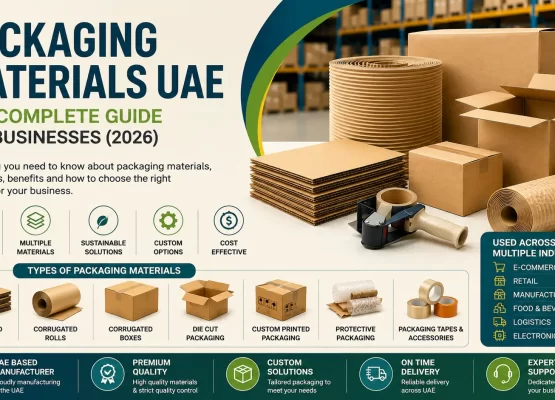
Packaging Materials UAE: The Complete Guide.
Introduction Packaging plays an important role in protecting products during storage, handling, transportation, and delivery. For.