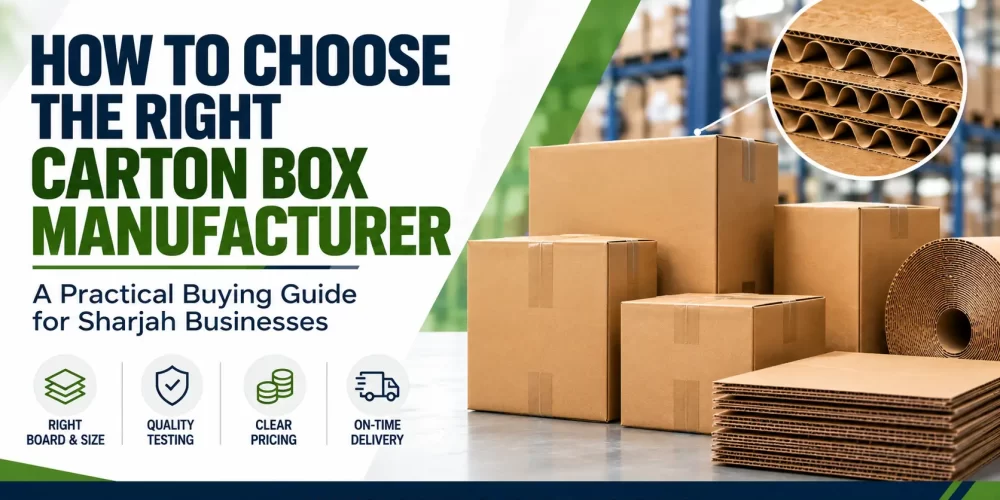
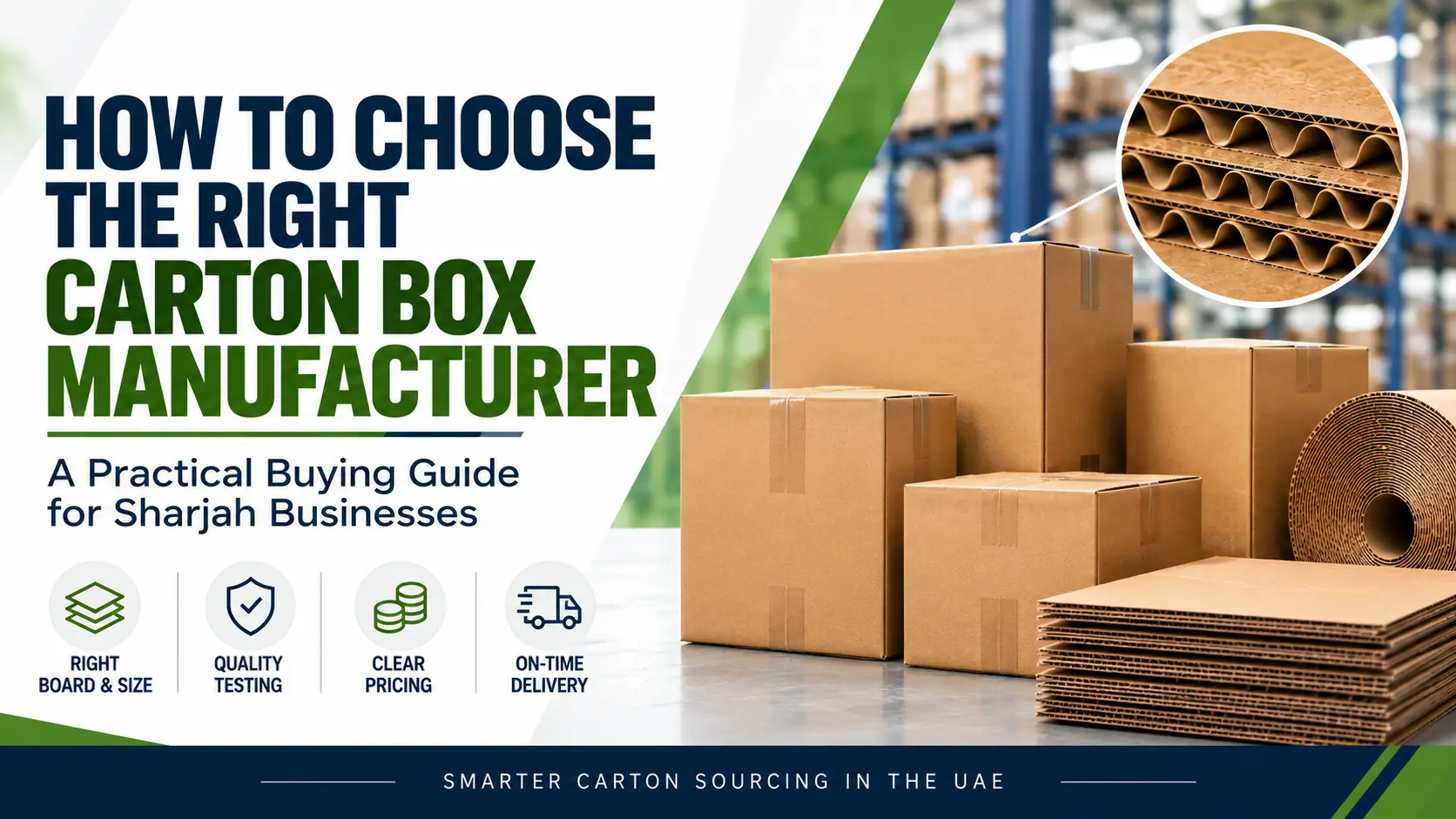
Buying cartons looks simple. You pick a size, get a quote, place the order. Then the boxes arrive crushed, too tight, or three weeks late.
Most of those problems start before the order. They start with a vague brief and an untested supplier.
This guide fixes that. You’ll learn how to choose the right board, size your boxes properly, read a quote, and vet a carton box manufacturer in Sharjah before you commit.
Quick Checklist Before You Contact Any Manufacturer
Have these ready. Quotes will come faster and be more accurate.
- Product weight and dimensions (with packaging inside, if any)
- How the box will travel: courier, pallet, container, or local van
- Monthly or per-order quantity
- Printing needs: plain brown, one colour, or full colour
- Storage conditions: humid warehouse, cold room, or open yard
- Target delivery date
No answers yet? Keep reading. Each section below helps you fill these in.
Why Source Cartons Locally in Sharjah
Sharjah is one of the UAE’s main manufacturing hubs. Many packaging plants sit in Al Sajaa Industrial Oasis and across Industrial Areas 1 to 17. Al Azra and nearby zones add more options.
Buying from a local factory gives you real advantages.
- Shorter lead times. The factory is close to your warehouse, so reorders move fast.
- Lower transit cost. Bulky, empty cartons are expensive to ship over long distances. They are mostly air.
- Easier sample approval. You can visit the factory, touch the board, and check print quality in person.
- Faster fixes. If a batch is wrong, a local plant can reprint or replace without weeks of back-and-forth.
- Simple dispatch across Emirates. Sharjah sits next to Dubai and Ajman, with road links to Abu Dhabi, Ras Al Khaimah and Fujairah.
One tip: ask whether you can collect from the factory gate. Pickup can save money on small, urgent orders. Confirm the loading hours and vehicle access first, because industrial zones have their own gate and truck rules.
Types of Carton Boxes You’ll See
Manufacturers use different names. Here is what each style means in plain terms.
Regular Slotted Containers (RSC)
The standard shipping box. All flaps are the same length, and the two outer flaps meet in the middle. It is cheap, strong, and easy to tape. Most warehouse and general shipping needs are covered by an RSC.
Mailer Boxes
One-piece, self-locking boxes that fold flat. They suit e-commerce, subscription kits, and gifts. They look neat when opened, and they use less tape and filler.
Die-Cut Boxes
Cut with a custom tool to fit a specific product. They hold items in place without foam or fillers. A die has a one-time setup cost, so they make sense for repeat orders. Browse our die-cut boxes to see the range.
Heavy-Duty Master Cartons
Built from thicker board to carry bulk loads, export goods, or stacked pallets. These usually use double or triple wall board.
Ventilated Produce Boxes
Vent holes let air circulate around fruit and vegetables. Check the wet-strength and coating options if boxes will sit in cold storage.
Technical Specs Made Simple
This is where most buyers get lost. It doesn’t need to be hard.
Ply: How Many Layers?
Corrugated board is made of flat paper liners with a wavy layer (the flute) between them.
- 3-ply (single wall): two liners, one fluted layer. Good for light to medium items.
- 5-ply (double wall): three liners, two fluted layers. Better for heavier or stackable goods.
- 7-ply (triple wall): four liners, three fluted layers. For very heavy, bulky, or export loads.
More ply means more strength, but also more weight and cost. Don’t over-spec. A 5-ply box for a 1 kg item wastes money. Our guide to single wall vs double wall corrugated boxes explains the trade-offs.
Flute: How Thick and How Rigid?
The flute profile changes how the board behaves.
- A-flute: thicker, more cushioning, lower print quality. Good for fragile items.
- B-flute: thinner and firmer, with a flatter surface. Prints well and resists crushing from the top.
- C-flute: the middle option. Strong stacking, decent cushioning, widely used for shipping.
Box makers often combine flutes in double wall board, such as BC. Ask what combination your quote uses.
ECT vs Bursting Strength
Two tests, two questions.
- Bursting strength (Mullen test) measures how much pressure it takes to puncture the board. It tells you about puncture resistance.
- Edge Crush Test (ECT) measures how much load the board edge can take before it collapses. It tells you about stacking strength.
If your boxes will sit on a pallet under other boxes, ECT matters most. Ask your supplier for the ECT value of the exact board in your quote. For more on how board performs under load, read about corrugated box strength. Avoid quotes that only say “strong” or “heavy-duty.”
Weight Capacity Quick Reference
Use this as a starting point only. Real capacity depends on box size, paper grade, and how the box is packed.
| Board type | Typical use | Indicative load per box |
| 3-ply single wall | Light retail, apparel, books | Up to about 10 to 15 kg |
| 5-ply double wall | Appliances, bottled goods, bulk food | About 15 to 30 kg |
| 7-ply triple wall | Machinery parts, export cartons | 30 kg and above |
Always test with your actual product. A sample run costs little. A failed shipment does not.
Paper Quality and Sustainability
Paper grade affects strength just as much as ply. Virgin kraft liners are stronger than recycled liners. Recycled content lowers cost and supports your sustainability goals.
More UAE buyers now ask for greener packaging. Retailers and large corporate clients often request it in supplier requirements. If this applies to you, ask your manufacturer about:
- Recycled content percentage
- FSC-certified paper options
- Fully recyclable kraft boxes with no plastic lamination
- Water-based inks instead of solvent-based ones
Get certificates in writing. A claim on a website is not proof. More on this in our guide to sustainable packaging in the UAE.
Industry Applications: Match the Box to the Job
Food and perishables. Ask about food-safe materials, moisture resistance, and ventilation. Confirm that inks and coatings are suitable for contact-adjacent use. See our guide to food packaging boxes in the UAE.
E-commerce. Mailer boxes or right-sized RSCs work best. Oversized boxes raise courier costs and filler use. More in our e-commerce packaging guide.
Logistics and export. Prioritise ECT, double or triple wall, and consistent dimensions that fit pallets well.
Moving and storage. Reusable, medium-weight boxes in standard sizes. Handles and reinforced bottoms help.
Retail and gifting. Print quality and finish matter more. Ask about colour matching and lamination.
Step-by-Step Buying Process
Step 1: Measure Properly
Wrong dimensions cause most box failures. Use our corrugated box sizes guide as a reference.
- Give internal dimensions in this order: length, width, height.
- Measure your product at its widest points.
- Add 10 to 20 mm clearance on each side if you need void fill or protection.
- Don’t force a tight fit. Compressed edges weaken the box and damage goods.
Also remember that external dimensions are larger than internal ones because of board thickness. Pallet planning needs external numbers. Product fit needs internal numbers. Keep them straight in every email.
Step 2: Get a Sample
There are two kinds.
- Digital mockup: a flat artwork proof. Good for checking layout and text.
- Physical sample: a real box made from your chosen board. Good for testing fit, strength, and print.
For first orders, ask for a physical sample. Drop-test it. Stack weight on it. Load it with your product and shake it.
Step 3: Understand MOQ and Setup Charges
Minimum order quantity (MOQ) is the smallest batch a factory will run. It varies with box size, print, and board.
Plain brown stock sizes usually have lower MOQs. Custom printed boxes and die-cuts need higher ones, because the factory must prepare printing plates or cutting tools. Learn more about custom printed corrugated boxes and corrugated box printing in Sharjah.
Ask the supplier directly:
- What is your MOQ for plain boxes? For printed ones?
- Do you charge for printing plates or die tooling?
- Are those charges one-time or per order?
- Do you store the tooling for reorders?
Step 4: Confirm Lead Time in Writing
“Fast delivery” means nothing. Ask for:
- Production time after artwork approval
- Delivery time to your location
- What happens if you reorder
Good suppliers give you numbers, not slogans.
Cost vs Volume: How Pricing Really Works
Carton pricing has two parts.
- Fixed costs: printing plates, die tooling, machine setup.
- Variable costs: board, ink, labour, and conversion per box.
Fixed costs get spread across your order. So unit price drops as volume rises.
Here is a simple illustration with made-up numbers. Suppose setup costs AED 600.
| Order size | Setup cost per box | Effect |
| 100 boxes | AED 6.00 | Setup dominates the price |
| 500 boxes | AED 1.20 | Noticeably cheaper |
| 1,000 boxes | AED 0.60 | Setup is a small share |
These figures are examples. Your quote will show real ones. The lesson is the same everywhere.
- Small runs of printed boxes cost more per piece. That is normal.
- Plain boxes avoid most setup charges. Consider plain boxes with a stamp or label for early orders.
- Reusing the same size and print keeps costs down. Fewer sizes means longer production runs. For more savings ideas, see how to reduce packaging costs.
When comparing quotes, line them up carefully. Check that every quote uses the same board, flute, dimensions, print, and quantity. A low price often hides a thinner board.
Sharjah Supplier Vetting Checklist
Print this and bring it to your next call or factory visit.
Capability
- Do they manufacture in-house, or trade and outsource?
- Which box styles and board types can they produce?
- Can they handle your print and finish requirements?
- Can they make die-cuts on site?
Quality
- Will they share ECT and bursting strength data for your board?
- Do they follow a quality control process? Ask to see it.
- Will they provide a physical sample before bulk production?
- How do they handle defects or short deliveries?
Commercial
- Is the quote itemised, including setup charges?
- What are the MOQs for plain and printed boxes?
- What are the payment terms?
- Can they show references from similar clients?
Logistics
- What is the stated lead time, in days?
- Do they deliver across the UAE, and what are the charges?
- Is factory pickup available in Sharjah?
- Can they store stock and release it in batches?
Sustainability
- Do they offer recycled or FSC-certified options?
- Can they provide certificates?
- Are their inks water-based?
A good manufacturer answers these without dodging. If the answers are vague, treat that as information. Our guide on how to choose the best packaging company in the UAE goes further.
Common Mistakes to Avoid
- Ordering by price alone. The cheapest box is expensive if it fails.
- Skipping the sample. Even simple boxes deserve one test run.
- Guessing dimensions. Measure the product, not the old box.
- Ignoring stacking. Boxes that survive shipping can still collapse in storage.
- Forgetting humidity. UAE summers and coastal air weaken ordinary board over time.
- Changing artwork late. Late changes delay production and add cost.
A Simple Way to Decide
Use this short test.
- Define weight, dimensions, and transport route.
- Pick ply and flute that match the load.
- Request quotes from three Sharjah manufacturers, using the same specs.
- Compare itemised pricing, lead time, and sample quality.
- Order a small trial run before committing to volume.
That process takes a little time upfront. It saves a lot of money later.
Frequently Asked Questions
What is the difference between a carton box and a corrugated box?
People use the terms loosely. “Carton” usually refers to the finished box. “Corrugated” describes the board it is made from, with its fluted middle layer. See what a carton box is and the types of carton packaging.
How do I know if I need 3-ply or 5-ply?
Start with weight and stacking. Light items shipped by courier often work in 3-ply. Heavy, stacked, or export loads usually need 5-ply or more. Test a sample to confirm.
Can I order a small quantity of custom boxes?
Often yes, but unit prices will be higher because setup costs are spread over fewer boxes. Plain boxes with labels are a cost-effective starting point.
How long does production usually take?
It depends on the order size, print complexity, and the factory’s schedule. Ask each supplier for a written timeline after artwork approval.
Do I need FSC-certified boxes?
Only if your customers, retailers, or internal policy require it. If sustainability is part of your brand, it is worth asking for.
Final Thoughts
The right carton box manufacturer in Sharjah does more than sell boxes. They help you choose the right board, avoid over-spending, and deliver on time.
Start with clear specs. Test a sample. Compare itemised quotes. Use the vetting checklist above. Do those four things, and you’ll avoid most of the problems buyers run into.
Ready to request quotes? Send your dimensions, quantity, print needs, and delivery location to your shortlisted manufacturers today, or request a quote from our team.


How To Choose Best Packaging Company.
Packaging is no longer just a protective layer around a product. It has become an essential.

Packaging Manufacturers in UAE: A Complete.
Packaging has become an essential part of modern business operations, helping companies protect products, improve logistics,.