
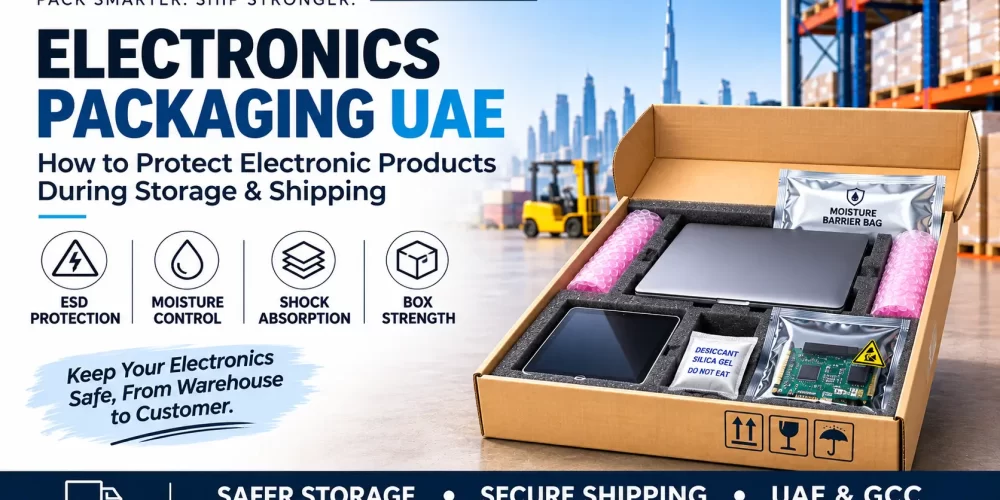
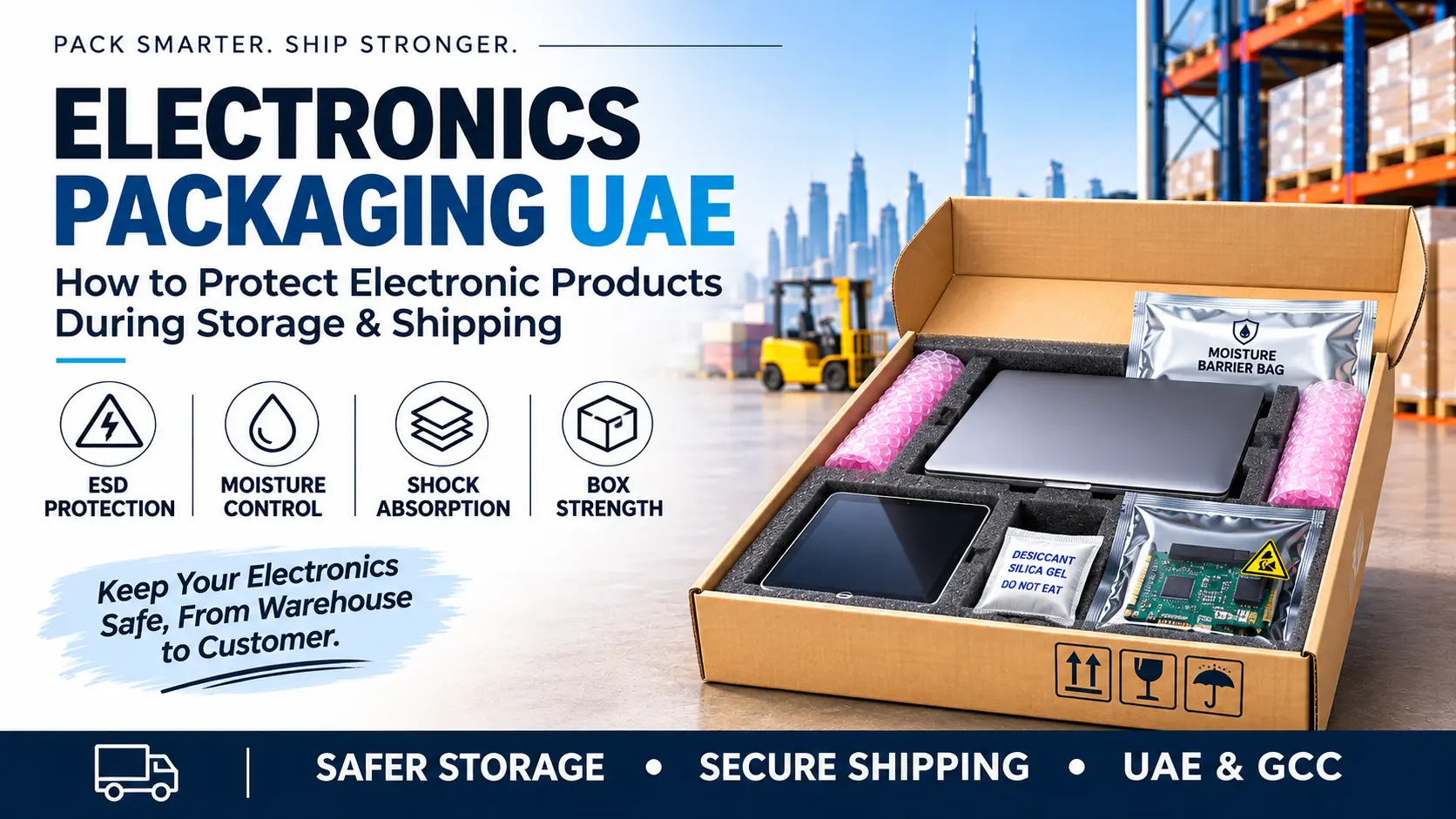
A laptop leaves a Dubai warehouse in perfect shape. It reaches the customer with a dead screen. Nothing looks wrong with the box.
This happens more than most sellers admit. Electronics are fragile in ways you can’t see. Static can kill a chip without a spark. Moisture can corrode a board weeks after delivery. And in the UAE, the climate adds its own stress to every shipment.
This guide shows you how to pack electronic products so they survive storage and shipping here. You’ll get a simple four-layer system, a box strength table, climate tips, compliance pointers and a checklist you can use today.
Why Standard Packaging Fails in the UAE Supply Chain
A normal brown box and a roll of bubble wrap work fine in mild climates. In the UAE, they often don’t.
Here is what your product actually faces:
- Extreme heat. A parked delivery van or a tarmac holding area can pass 45°C. Some tapes soften and let go. Some plastics warp.
- High humidity. Coastal areas like Dubai and Abu Dhabi can hit 80% humidity or more. Moisture finds its way into poorly sealed cartons.
- Cold indoor air. Offices and warehouses run at 18–20°C. A box moving from a hot van into cold AC creates condensation fast.
- Vibration. Trucks, vans and conveyor lines shake a product for hours.
- Stacking pressure. Pallets sit under tall loads in warehouses and containers. Weak boxes crush from the bottom up.
- Electrostatic discharge (ESD). Handling and friction build static. A sensitive circuit board can fail without any visible mark.
One fix doesn’t cover all of this. Cushioning stops drops, but it does nothing for moisture. A sealed bag blocks humidity, but it doesn’t absorb shock. You need layers that work together.
The 4-Layer Electronics Protection System
Think of each shipment as four layers. Each one solves a different problem.
Layer 1: ESD Shielding
Static damage is silent. Your customer may only notice weeks later, when the device starts acting up.
For circuit boards, drives, memory modules and similar parts:
- Use static-shielding bags or conductive bags around bare assemblies.
- Use anti-static bubble wrap for items that need extra cushioning.
- Keep standard polyethylene bubble wrap away from exposed components. It can build up charge.
- Seal the bag fully. A half-open bag shields very little.
Finished consumer products in their retail boxes usually need less ESD care. Bare boards and components need all of it.
Layer 2: Moisture Barrier
If you ship or store electronics for more than a few days, add a moisture barrier.
- Place the product in a sealed moisture-barrier bag.
- Add a desiccant pack inside the bag.
- Heat-seal or tightly close the bag so air can’t pass.
This step matters most for sea freight, long storage and shipments that cross climate zones.
Layer 3: Custom Cushioning
Cushioning stops the product from moving. Movement is what causes damage.
The common options:
- Custom-cut foam inserts for high-value or oddly shaped items
- Air cushions or air pillows for light void fill
- Honeycomb paper wrap for a recyclable alternative
- Corrugated rolls and pads for wrapping and corner protection
- Bubble roll for general surface protection
The rule is simple. The product should not shift when you shake the box. If it rattles, add more fill.
For short runs, standard materials work. For regular volumes of the same product, a die-cut insert gives a snug fit and faster packing. See our die-cut boxes range for fitted designs.
Layer 4: The Structural Outer Carton
The outer box takes the hits. It also carries the stacking load.
Choose the carton by product weight, fragility and shipping route. The next section shows you how.
Corrugated Box and Flute Selection Guide
Most sellers pick a box by size alone. That’s a mistake. Strength matters just as much.
Flute basics
Flute is the wavy layer between the liners. Its height changes the box’s behavior:
| Flute | Approx. thickness | Best for |
| E-flute | 1.5 mm | Retail boxes, small products, good print quality |
| B-flute | 2.5 mm | Crush resistance, inner packs |
| C-flute | 3.5 mm | General shipping, good stacking strength |
| BE-flute | 4 mm | Double-wall cartons for heavier or fragile loads |
Want to understand how wall type changes protection? Our guide on single-wall vs double-wall corrugated boxes explains it in plain terms.
ECT rating by product weight
Edge Crush Test (ECT) measures how much load a box edge can take before it collapses. A higher number means a stronger carton. Use the table below as a starting point.
| Packed weight | Suggested construction | Typical ECT |
| Up to 5 kg (phones, tablets, accessories) | Single wall | 32 ECT |
| 5–15 kg (laptops, monitors, small devices) | Single wall, heavy-duty | 44 ECT |
| 15–25 kg (printers, networking gear) | Single wall at 51 ECT or double wall | 51 ECT and above |
| 25 kg and above (servers, large equipment) | Double wall or tri-wall | Confirm with supplier |
These are guidelines, not guarantees. Your product’s shape, value and route can change the answer. Fragile or high-value items deserve a step up.
For a deeper look at strength and how it’s measured, read our corrugated box strength guide.
Test before you commit
Don’t guess. Test.
- ISTA 3A simulates parcel shipping, including drops and vibration. It’s a widely used benchmark for packaged products.
- Run a few drop tests from waist height on every face, edge and corner.
- Check for internal movement after each drop.
If a prototype fails, fix the cushioning or box grade before you print 5,000 units.
Get the size right
A box that is too big wastes fill material and raises courier costs. One that is too small crushes the product. Our corrugated box sizes guide helps you pick dimensions with proper clearance. When no standard size fits, a custom corrugated box solves it.
Managing UAE Storage Conditions: Condensation, Desiccants and Acclimation
Many electronics don’t get damaged on the road. They get damaged in the storeroom or right after delivery.
How condensation happens
Warm, humid air carries a lot of water. When it meets a cold surface, the water turns to droplets. If a cold device in a sealed bag lands in a hot, humid space, droplets form on the product. If a hot box moves into a cold room, the same thing can happen inside the box.
In the UAE, this swing is common. Think of a cold AC warehouse and a hot loading bay ten metres apart.
Use desiccants correctly
Silica gel and clay desiccants soak up moisture inside a sealed bag. Too little and they fail. Too much wastes money.
A practical way to size them:
- Measure the internal volume of the sealed bag in cubic metres.
- Use the desiccant maker’s rating as your base. As a rough starting point for short storage, many packers use around 1 kg of silica gel per cubic metre of sealed space.
- Increase the amount for long storage, sea freight or thin barrier film.
- Keep a humidity indicator card inside the bag.
Always check the supplier’s data sheet. Ratings vary by product.
Aim for 40–60% relative humidity
Inside the package, target 40–60% relative humidity.
- Below 40%, static builds up more easily.
- Above 60%, corrosion risk climbs.
A humidity indicator card gives you a quick visual check.
Let products acclimate before opening
This step is simple and often skipped.
- Move the sealed box into the room where it will be used.
- Leave it unopened until it reaches room temperature.
- For a laptop-sized carton, a few hours is a reasonable rule of thumb. Pallets and large equipment need longer, sometimes overnight.
Open it too early and condensation forms on the cold surfaces of the device.
Watch your tape
Heat attacks adhesives. A tape that holds in an air-conditioned office can lift in a 45°C van.
- Choose tapes rated for high temperatures.
- Avoid low-quality tapes with weak adhesive.
- Press seams down firmly and use the H-taping method: seal the center seam, then both edge seams.
Our guides on choosing the right adhesive packaging tape and BOPP tape types and uses will help you pick one. You can browse the full adhesive tape range too. Want your brand on the seal? See custom printed packaging tape.
UAE and GCC Shipping Compliance
Good packaging also needs to meet the rules. Check the following before every export or retail run.
Product labeling and conformity
- MoIAT (the UAE Ministry of Industry and Advanced Technology, which took over many functions of ESMA) oversees many product standards and conformity requirements.
- Regulated electronics may need the ECAS mark (Emirates Conformity Assessment Scheme). Confirm whether the mark must be visible on retail or outer cartons.
- Labels commonly need Arabic and English information. Confirm exact requirements for your product category.
Rules change. Always verify current requirements with the relevant authority or your customs broker.
Lithium batteries
Many electronics carry batteries, and batteries carry special rules.
- Know whether your battery is lithium-ion or lithium-metal.
- Protect the terminals so they can’t short-circuit.
- Use correct hazard and fragile labels.
- Confirm carrier rules before you ship. Many carriers limit or refuse certain battery shipments, especially by air.
Export and re-export
- Prepare the commercial invoice and air waybill correctly.
- If you use wooden pallets or crates, check ISPM-15 treatment requirements for export.
- Follow Dubai Customs and free zone palletization guidelines when re-exporting across the GCC.
Ask your freight forwarder to review your documents before the first shipment. It saves days later.
Last-Mile Realities for UAE Couriers and Fulfillment
Most damage happens in the final stretch. Automated sorting, rushed handling and tall stacks are all risks.
- Mind volumetric weight. Couriers often charge by box size, not just weight. Right-sizing your carton can cut shipping costs. Our post on reducing packaging costs shows how.
- Use tamper-evident tape or seals on phones, laptops and other high-value items.
- Place barcodes on a flat face. Keep them clear of seams and tape so scanners read them first time.
- Double-box very expensive or fragile items. Use an inner box with fitted cushioning, then an outer box with room around it.
Selling online? Our e-commerce packaging guide for the UAE covers mailers, sizing and unboxing.
Eco-Friendly Anti-Static and Protective Packaging Alternatives
Businesses across the UAE are cutting single-use plastic. Many corporate buyers now ask suppliers about sustainability. Government restrictions on single-use plastics also keep expanding, so check the latest rules for your emirate.
You can protect electronics without relying on foam and standard bubble wrap:
- Molded pulp inserts hold products firmly and recycle easily.
- Honeycomb paper cushioning absorbs shock and is fully paper-based.
- Kraft paper void fill replaces plastic air pillows for lighter products.
- Corrugated pads and dividers separate and protect items in multi-unit boxes.
- Anti-static paper options exist for components that need ESD care. Confirm the rating with the supplier.
One warning. Don’t swap materials and assume the result is safe. Run your drop tests again after any change.
Learn more in our guide to sustainable packaging in the UAE, or explore packaging materials in the UAE.
Pre-Shipment Inspection Checklist for UAE E-Commerce and B2B Exporters
Print this list. Tick every item before a pallet leaves your warehouse.
Product and ESD
- Accessories, cables and loose parts removed or secured
- Sensitive boards sealed in static-shielding bags
- No standard plastic wrap touching bare components
Moisture and climate
- Moisture-barrier bag sealed for long storage or sea freight
- Desiccant sized for the bag volume
- Humidity indicator card inside
- Tape rated for high temperatures
Cushioning and box
- Product doesn’t move when you shake the box
- Box ECT matches product weight
- At least 5 cm of clearance from box walls for fragile items
- H-tape applied on all seams
Labels and documents
- Fragile and orientation labels visible
- Barcode on a flat, clear surface
- Battery labels and paperwork complete
- Arabic and English labeling checked where required
- Commercial invoice and air waybill ready
Final checks
- Tamper-evident seal on high-value items
- Sample box passed a drop test
- Pallet wrapped and corners protected
Final Thoughts
Electronics packaging in the UAE isn’t about buying the thickest box. It’s about matching the packaging to the real conditions: heat, humidity, static, vibration and rough last-mile handling.
Start with the four layers. Pick the right ECT rating. Control moisture. Check your labels and paperwork. Then test a sample before you scale.
Need help choosing the right cartons, die-cut inserts or tapes? Explore our corrugated carton box range and custom packaging solutions, or contact the Mufeed Pack team for a quote on packaging built for your products.

How to Choose the Right Corrugated.
Choosing the right packaging size is an important part of protecting products during storage, handling, and.
How to Choose the Right Corrugated.
A box that crushes at the port costs far more than the box itself. You pay.