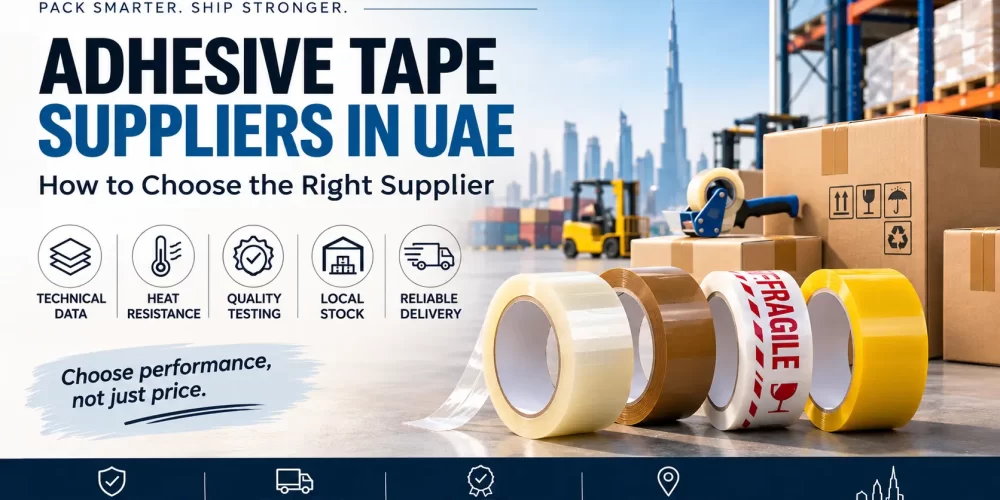
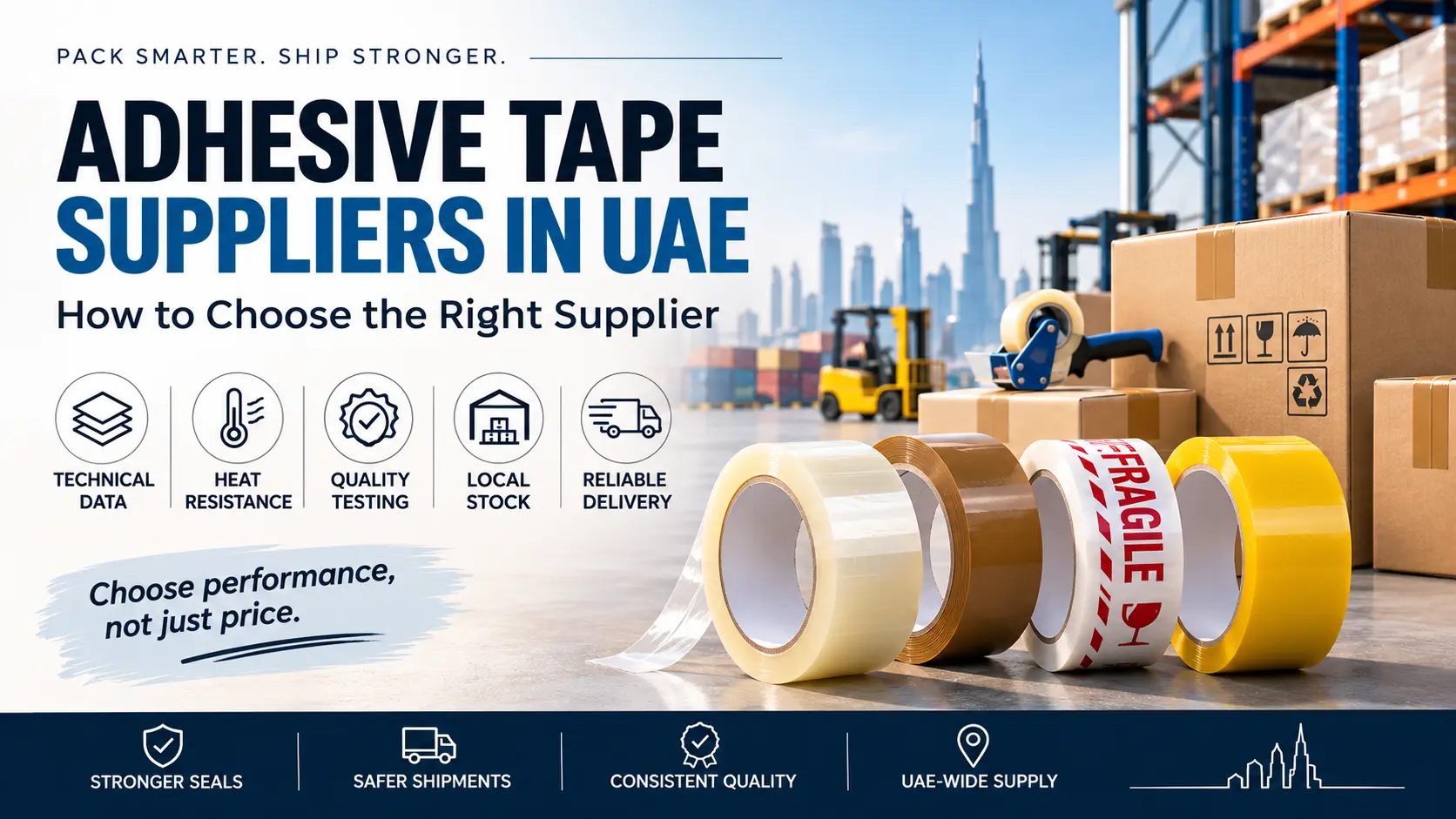
A roll of tape costs a few dirhams. A pallet of cartons that pop open in a container costs far more.
Most buyers in the UAE compare adhesive tape suppliers on roll price, then discover the real costs later. Tape fails in a hot warehouse. Printed rolls arrive late. A supplier can’t produce a datasheet when a customer complains.
This guide shows you how to pick a supplier who prevents those problems. It covers what to define before you request quotes, how adhesive chemistry behaves in Gulf heat, what to ask suppliers, and how to calculate what tape really costs you.
Why the Supplier Matters More Than the Tape
Most suppliers in the UAE stock the same headline products: BOPP, masking, aluminium foil, double-sided and duct tape. The catalogues look alike.
The difference is in the details a catalogue doesn’t show:
- Which adhesive is on the roll
- How the stock was stored before it reached you
- Whether the supplier can match a tape to your actual surface and conditions
- Whether they hold stock locally or depend on long import lead times
A supplier who can’t answer those questions is selling you a roll, not a solution. A good one helps you avoid the wrong tape in the first place.
Step 1: Map Your Requirements Before You Ask for Quotes
Suppliers quote what you ask for. If your request says “brown tape, 48mm,” you’ll get a price for brown tape, 48mm. It may not be the right tape.
Write down these five things first.
What are you sticking to?
Corrugated board behaves very differently from powder-coated metal, glass or stainless steel. Recycled board is rough and fibrous, so it needs aggressive tack. Smooth, low-energy surfaces need a different adhesive approach.
Where will it be used?
- Inside an air-conditioned packing line
- In an un-cooled warehouse in Sharjah or Jebel Ali
- Outdoors on a construction site
- Inside a container sitting in port
How will it be applied?
Hand dispensers and automatic case sealers need different roll specifications. Machine rolls must unwind cleanly and quietly at speed. A roll that works by hand can jam a machine.
What volumes do you need?
Your monthly usage determines whether you should buy by the carton, the pallet or on a scheduled call-off. It also affects whether custom printing makes financial sense.
How long will the tape stay on?
Carton sealing for a few days is one job. Surface protection that stays on for months is another. A tape that leaves residue after six weeks of sun is the wrong tape, however cheap.
Once you have those answers, your quotes become comparable.
Step 2: Understand Adhesive Technology (This Is Where UAE Heat Matters)
Most supplier guides skip this part. They shouldn’t. In the Gulf, adhesive chemistry decides whether a tape works.
Summer temperatures often pass 45°C. Inside a parked container or a metal-roofed warehouse, it gets hotter. Adhesives soften, creep and lose grip under those conditions.
Here are the three main adhesive types you’ll meet.
Hot-melt synthetic rubber
- Very high initial tack
- Grips rough, recycled cartons well
- Cost-effective for general carton sealing
- Can soften and lose holding power in sustained heat
Best for: short-cycle sealing in controlled or moderate conditions.
Risk in the UAE: cartons stored or shipped hot may see flaps lift or “pop” as the adhesive creeps.
Acrylic (water-based or solvent)
- Holds up better against heat, UV and ageing
- Stays stable over longer storage times
- Slightly lower initial tack than hot-melt
- Common on standard clear BOPP tape
Best for: long storage, hot warehouses, export shipments, and any tape exposed to light.
Solvent-based rubber
- Strong, aggressive grip
- Handles demanding applications and difficult surfaces
- Costs more
Best for: heavy cartons, tough substrates and cold-chain or mixed conditions.
Silicone and specialty adhesives
For high-temperature masking, automotive work and some outdoor use, silicone or specialty acrylic systems are the right choice. Ordinary tape won’t survive.
What this means for you
Ask every supplier: “Which adhesive is on this tape, and what temperature range is it rated for?”
If they can’t tell you, move on. A supplier who understands your climate will recommend an acrylic tape for a hot storage environment and a hot-melt tape for a fast packing line. A supplier who doesn’t will quote the cheapest roll.
For more on matching tape to packaging, see Al Mufeed’s guide to choosing adhesive packaging tape in the UAE.
Step 3: Match Tape Type to Application
A good supplier carries a broad range and tells you which one fits. These are the common categories.
| Tape type | Typical use | Watch out for |
| BOPP (clear or brown) | Carton sealing, e-commerce, general packing | Adhesive type, film thickness |
| Masking tape | Painting, automotive masking, light-duty holding | Temperature rating, clean removal |
| Aluminium foil tape | HVAC ducting, insulation, heat reflection | Foil thickness, adhesive stability |
| Double-sided tissue or foam | Mounting, bonding, signage | Surface compatibility, load rating |
| Duct tape | Repairs, bundling, general-purpose fixing | Not suited to permanent sealing |
| Surface protection tape | Protecting glass, metal and floors on site | UV resistance, residue risk |
| Floor marking tape | Warehouse zones, safety lines | Abrasion and traffic resistance |
For packaging teams, BOPP tape is the daily workhorse. Mufeed Pack covers it in detail in its BOPP tape guide for the UAE, including types and use cases. For industrial buyers, the industrial adhesive tape page is a useful reference.
Step 4: Check Surface Compatibility
Tape doesn’t stick equally well to everything. The physics is surface energy.
- High surface energy materials (corrugated board, bare metal, glass) generally accept adhesive easily.
- Low surface energy materials (some plastics, powder coatings, oily or waxed surfaces) resist bonding.
Practical rules:
- Recycled corrugated board: rough and dusty. Use a tape with strong tack, or increase tape width.
- Powder-coated metal: smooth and sometimes slightly low-energy. Test before bulk buying.
- Stainless steel and glass: clean surfaces bond well, but dust, oil and fingerprints ruin the grip.
- Painted walls: pick a masking tape rated for the paint type and cure time.
Ask your supplier for a sample run on your actual material. A supplier who offers samples is confident in the product. One who refuses is a warning sign.
Board quality matters too. Weak or dusty board will fail whatever tape you use. For background, read how corrugated box strength affects performance.
Step 5: Vet the Supplier With a Checklist
Here is a practical rubric for procurement teams. Score each supplier against it.
Product and technical support
- Provides a technical data sheet (TDS) for each tape
- States adhesive type, film thickness (microns) and temperature range
- Quotes peel adhesion and shear strength values, ideally to a recognised test standard such as ASTM or an ISO equivalent
- Can explain why a tape suits your application
- Offers samples before bulk orders
Stock, lead time and MOQ
- Holds local stock in the UAE rather than importing every order
- States clear minimum order quantities for standard and custom items
- Gives realistic lead times, in writing
- Can support repeat call-off orders
A low MOQ is useless if the lead time is six weeks. A fast lead time is useless if every order needs a huge minimum. Look at both together.
Storage and shelf life
- Stores tape in temperature-controlled or well-ventilated conditions
- States a shelf life and explains how it is affected by storage
- Rotates stock (first in, first out)
Tape left in a hot, humid store loses tack long before you open the box. Ask how your supplier stores stock before it ships.
Customisation
- Prints custom logos on BOPP tape
- Offers custom roll lengths and widths
- Shows artwork proofs before production
- States printing MOQs and turnaround
If you ship to customers, branded tape adds a professional finish. See Mufeed Pack’s page on custom printed packaging tape in the UAE.
Coverage and delivery
- Delivers across Dubai, Sharjah, Abu Dhabi, Ajman and the Northern Emirates
- Serves free zones such as JAFZA
- Offers scheduled deliveries for factory customers
Trust signals
- Visible facility, team and contact details
- Consistent answers from sales and technical staff
- References or a track record with similar businesses
A supplier with a real factory and a real address is easier to hold accountable. You can see how Al Mufeed operates on its facility page and learn more on the about page.
For a broader view of choosing a packaging partner, this guide on how to choose the best packaging company in the UAE covers the same thinking, as does the article on factors to consider when selecting a custom packaging supplier.
Step 6: Test Quality and Compliance
Don’t take claims on trust. Run simple checks on every new supplier’s tape.
Peel and shear test
Stick a strip to your actual carton or surface. Wait 24 hours. Pull it off by hand and note the resistance. Then hang a weight from a strip and see how long it holds. This isn’t lab-grade, but it catches poor tape quickly.
Heat test
Seal a carton and leave it in a warm location for several days, ideally somewhere that matches your real storage. Check whether flaps lift or the tape creeps.
Residue test
For masking and surface protection tape, leave a strip on the surface for the period you’d normally need. Remove it and check for adhesive residue or surface damage.
Unwind test
Run a roll on your machine or hand dispenser. Listen for noise. Watch for tearing, stretching or telescoping (where the roll slides sideways).
Batch consistency
Order a second batch and compare it with the first. Consistent supplier quality matters more than one good sample.
Record the results. They give you evidence the next time you negotiate.
Step 7: Calculate Total Cost of Ownership
Roll price is the most visible number. It’s rarely the most important one.
Where cheap tape costs you money
- Extra wraps. Weak tape forces packers to apply two or three strips where one should do.
- Failed seals. Open cartons mean damaged goods, returns and replacements.
- Slower lines. Tape that tears or jams slows your packers and stops machines.
- Wasted rolls. Tape that loses tack in storage gets thrown away.
- Reputation damage. Customers who receive an open parcel don’t care why.
A simple way to compare
For each tape you’re considering, calculate:
Cost per sealed carton = (cost per roll ÷ cartons sealed per roll) + failure cost
A tape that costs 15% more per roll but seals more cartons and fails less often usually wins. A thicker film or better adhesive can reduce usage enough to pay for itself.
Manual versus machine application
Automatic case sealers use tape faster and more evenly, but they need consistent roll quality. If you’re moving from hand packing to machines, tell your supplier. They should recommend a machine-grade roll.
Mufeed Pack explores this theme in its guide to reducing packaging costs. For e-commerce sellers, the e-commerce packaging guide shows how tape fits into the full pack-out.
Red Flags When Comparing Suppliers
Walk away, or at least ask harder questions, when you see any of these:
- No datasheet available
- Vague answers about adhesive type
- Prices far below every other quote
- No samples offered
- No clear lead time
- Reluctance to put specifications in writing
- Stock stored in poor conditions
- Sales staff who can’t answer technical questions
One red flag is a reason to ask questions. Several together are a reason to look elsewhere.
Bundle Tape With Your Other Packaging
Many buyers source tape, cartons and packing materials from different vendors. That adds admin and creates blame games when something fails.
A supplier who also makes cartons can recommend tape that suits their own boxes, because they know the board grade and flap design. That removes a common source of failure.
Al Mufeed supplies corrugated packaging boxes, packaging materials and adhesive tape from the same business. For a view of the full product range, see the products page. For factory and industrial buyers, the industrial packaging company page explains how supply works at scale.
For a wider look at how to evaluate adhesives, this earlier guide on choosing the right adhesive tape is also worth reading.
Final Thoughts
Choosing among adhesive tape suppliers in the UAE isn’t about finding the lowest quote. It’s about finding the supplier whose tape will still be holding when the container opens.
Define your application first. Understand adhesive chemistry in the Gulf’s climate. Ask for datasheets and samples. Test the tape yourself. Compare cost per sealed carton, not cost per roll.
Do that, and you’ll cut failures, waste and complaints. Your packing line will run smoother, and your customers will receive their parcels sealed.
Need help matching tape to your application? Talk to the team at Al Mufeed through the contact page and ask for samples to test on your own cartons.

How to Choose the Right Corrugated.
A box that crushes at the port costs far more than the box itself. You pay.
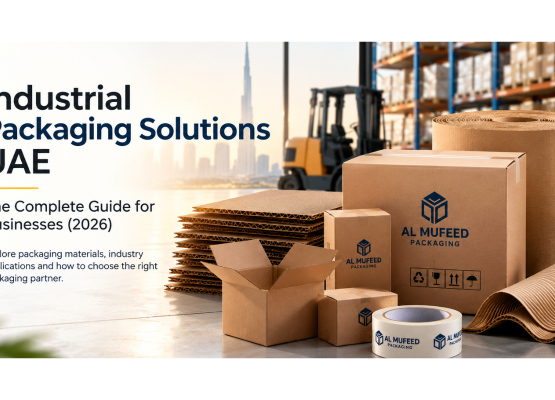
Industrial Packaging Solutions UAE: The Complete.
Packaging Is More Than Just Protection Industrial packaging has evolved far beyond simply placing products in.